
Growth Hormone Signaling: GHRH, GH, and IGF-1
Research Area: Cellular Growth & Tissue Repair Research
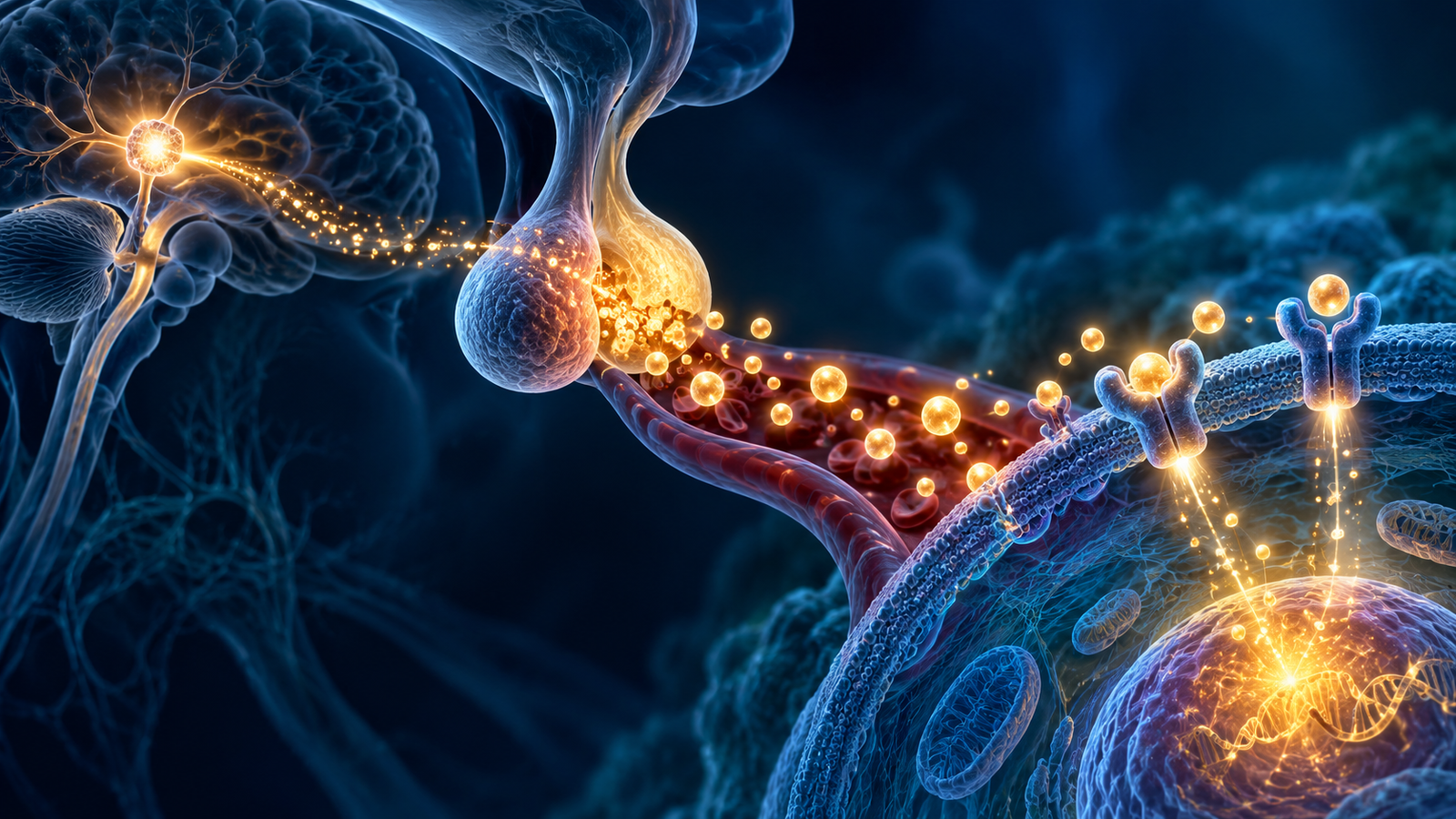
The growth-hormone pathway is not one signal acting alone. It is a connected chain that begins with messages to the pituitary gland, continues through growth hormone, and reaches IGF-1 and several internal cell pathways. Understanding where a compound enters that chain explains why related products can produce different timing and measurements.
The pathway from GHRH to IGF-1
- The hypothalamus sends GHRH, or growth-hormone-releasing hormone, to the pituitary gland.
- GHRH binds its receptor and helps trigger a pulse of growth hormone.
- Growth hormone travels to tissues and binds the growth-hormone receptor.
- The receptor activates relay systems including JAK2 and STAT5.
- Those signals change gene activity, including instructions involved in IGF-1 production.
- IGF-1 binds its own receptor and influences growth, survival, metabolism, and tissue maintenance pathways.
JAK2 is an enzyme attached to the inside of the growth-hormone receptor. STAT5 is a protein that carries the message toward the cell nucleus, where genes are controlled. IGF-1 is a separate messenger—not simply another name for growth hormone.
Why pulses and feedback matter
Growth hormone is normally released in pulses rather than at one steady level. The size and spacing of those pulses can affect how receptors respond. Somatostatin, another hypothalamic signal, helps limit release. IGF-1 and growth hormone also participate in feedback loops that tell the system when to reduce further signaling.
Because of this feedback, a longer signal is not automatically a better signal. Researchers measure the peak, the total exposure over time, the spacing of pulses, and how quickly the system returns toward baseline.
Where CellTek products enter the map
| Compound | Research entry point | Key distinction |
|---|---|---|
| Sermorelin | GHRH receptor | Short GHRH-related sequence |
| Tesamorelin | GHRH receptor | Stabilized GHRH-related analog |
| CJC-1295 DAC | GHRH receptor | Extended exposure through albumin binding |
| CJC-1295 No DAC | GHRH receptor | Shorter exposure design |
| Ipamorelin | Growth-hormone secretagogue receptor | Ghrelin-related receptor pathway |
| HGH | Growth-hormone receptor | Acts downstream of pituitary release |
Key findings researchers measure
- CJC-1295 research has reported prolonged changes in measured growth hormone and IGF-1.
- Research on GHRH analogs has examined whether natural growth-hormone pulsatility remains visible during stimulation.
- Growth-hormone receptor studies map JAK2, STAT5, MAPK, and PI3K-AKT as major internal signaling routes.
- Ipamorelin research distinguishes growth-hormone secretagogue signaling from direct GHRH-receptor signaling.
How this relates to tissue repair
The GH-IGF-1 axis can influence protein production, cell survival, metabolism, and the activity of cells involved in building tissue. Repair still requires more than growth signaling. Cells must arrive at the correct place, blood vessels must support the area, structural material must be organized, and excessive inflammation must resolve.
This is why the growth-hormone pathway and compounds such as BPC-157 or TB-500 belong on the same research map but not in the same mechanistic category. One group primarily changes endocrine messages; the other is studied around local repair-related processes.
Common questions
Does every growth-hormone secretagogue use the GHRH receptor?
No. Sermorelin, Tesamorelin, and CJC compounds are GHRH-related. Ipamorelin acts through the growth-hormone secretagogue receptor, which is also associated with ghrelin signaling.
Why measure IGF-1?
IGF-1 is a major downstream signal that shows the pathway extended beyond a short growth-hormone pulse. Researchers still interpret it with timing, receptor activity, and tissue-specific measurements.
Further reading
Compare CJC-1295 DAC and No DAC, review Sermorelin, Tesamorelin, and Ipamorelin, or return to Cellular Growth & Tissue Repair Research.
References
- The GH–STAT5–IGF-1 transcriptional circuit (PubMed)
- Growth-hormone receptor activation and signaling (PubMed)
- Prolonged GH and IGF-1 signaling with CJC-1295 (PubMed)
- Growth-hormone pulsatility during CJC-1295 signaling (PubMed)
- Ipamorelin as a selective growth-hormone secretagogue (PubMed)
For research and educational purposes only. Not for human or animal consumption.
