
Research Center
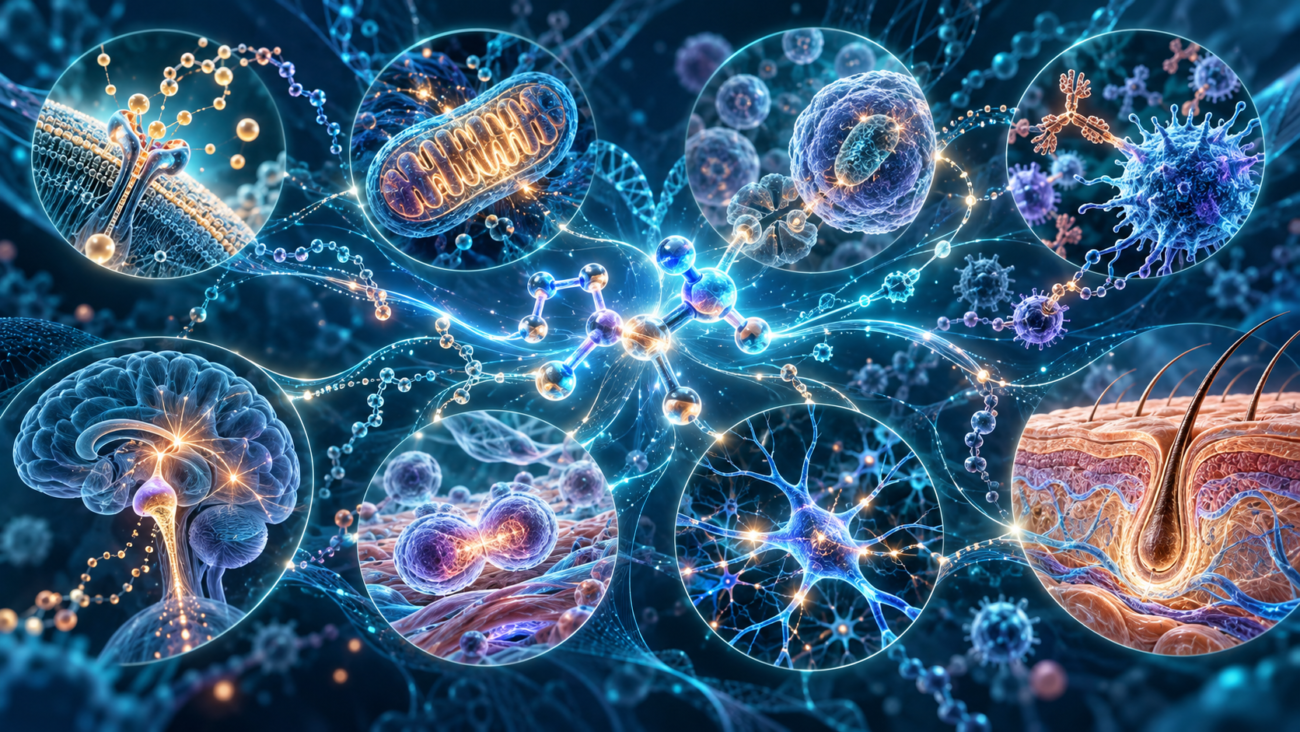
The CellTek Research Center organizes peptide and compound research by the biological systems being studied. Each area begins with the system itself—how cells communicate, use energy, coordinate repair, or respond to stress—then connects those ideas to specific compounds, product pages, comparison articles, and published references.
Start with the question, not the product
A compound can affect more than one pathway, and a pathway can influence more than one tissue. The most useful starting point is the question a study is trying to answer. Is the focus receptor signaling, energy production, inflammatory messages, cell movement, pigment production, or a change in the structural material around cells? Beginning with the measured system makes it easier to understand why one compound may appear in several research areas.
Understanding Peptide Research explains the terms used throughout the center, including receptors, signaling pathways, analogs, fragments, biomarkers, potency, and duration.
Explore the research areas
Metabolic Signaling Research
Explore GLP-1, GIP, glucagon, amylin, and related signals involved in nutrient sensing, fuel use, appetite-related communication, and energy balance. Individual articles explain single-, dual-, triple-, and amylin-centered research designs.
Mitochondrial & Cellular Energy Research
Follow how mitochondria convert nutrients into usable cellular energy, maintain their membranes, respond to stress, and communicate with the rest of the cell. This area connects MOTS-C, SS-31, NAD+, and related metabolic systems.
Regeneration, Aging & Longevity Research
Examine the maintenance systems associated with cellular aging, including telomere biology, DNA repair, NAD+-dependent reactions, mitochondrial stress signals, and the difference between a molecular aging marker and a broader biological outcome.
Immune & Inflammatory Signaling Research
See how immune coordination, inflammatory activation, inflammatory resolution, barrier tissues, and repair signals differ. The associated articles compare Thymosin Alpha-1, KPV, and ARA-290 without treating all immune-related activity as the same mechanism.
Reproductive & Neuroendocrine Research
Trace communication between the brain, pituitary gland, hormone-producing organs, and receptor systems. This area maps Kisspeptin-10, HCG, Oxytocin, and PT-141 to their different entry points in neuroendocrine signaling.
Cellular Growth & Tissue Repair Research
Study the growth-hormone signaling chain alongside separate repair pathways involving cell migration, blood-vessel signals, actin, and extracellular-matrix remodeling. The product directory distinguishes GHRH-related peptides, HGH, AOD-9604, BPC-157, and TB-500.
Neuroscience & Cognition Research
Explore neurotrophic signaling, inhibitory and excitatory balance, gene regulation, oxidative stress, sleep-wake measurements, and signaling that crosses between the nervous, immune, and endocrine systems.
Dermal, Follicular & Tissue Research
Examine skin matrix remodeling, follicle cycling, pigment biology, keratinocyte signaling, vesicle release, and multi-peptide repair blends. This area connects GHK-Cu, SNAP-8, KPV, Melanotan-2, GLOW, and KLOW to focused articles.
How the pages connect
Each research area works as a hub. The main page explains the biological system and includes a Learn More by Product directory. A product name opens the related catalog page. The article beside it explains the compound’s mechanism, the measurements researchers follow, important comparisons, common questions, and references. Every article links back to its research area so readers can move between the focused topic and the broader system.
One compound can belong to several areas
Biology is a connected network. NAD+ participates in energy transfer, but NAD+-dependent reactions are also tied to DNA maintenance and aging research. Oxytocin is a neuroendocrine signal, yet its receptor is also studied in the brain. KPV is connected with inflammatory signaling and appears in a dermal blend. Cross-listing reflects the pathway being discussed; it does not mean every page is describing the same outcome.
A useful way to follow a research claim
- Name the compound precisely. A full peptide, a fragment, an analog, and a blend are different research materials.
- Identify the entry point. Determine which receptor, enzyme, membrane, or structural protein is involved first.
- Follow the signal. Look for the internal relay that connects the entry point to a cell response.
- Check the measurement. A receptor signal, gene change, protein level, tissue measurement, and visible outcome answer different questions.
- Compare like with like. Timing, concentration, formulation, and the exact measured outcome must match before two findings can be treated as equivalent.
Common questions
Why are comparison articles included?
Closely discussed compounds often enter a system through different receptors or pathways. Comparison articles separate those mechanisms and show which measurements can reasonably be compared.
Why do some products link to the same article?
A shared article is useful when the research question is the distinction between products, such as CJC-1295 with and without DAC or KPV compared with Melanotan-2. The article keeps the comparison in one place while each product retains its own catalog page.
What does “key finding” mean on these pages?
It identifies a reported result that helps explain the pathway or compound. The meaning stays limited to the exact compound, conditions, and measurement described; it is not a promise that every later outcome follows.
References
- Trends and continuing challenges in peptide research (PubMed)
- Peptide therapeutics: current status and future directions (PubMed)
- Peptides that target cell-receptor systems (PubMed)
For research and educational purposes only. Not for human or animal consumption.
