
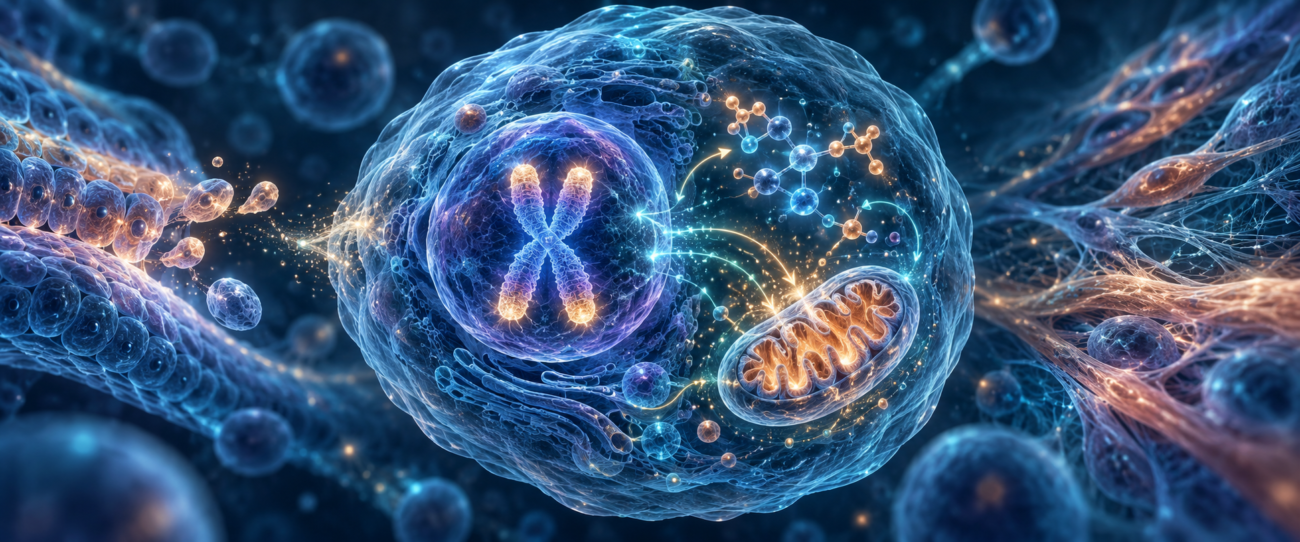
Regeneration, Aging & Longevity Research
Aging research asks why cells and tissues gradually lose the ability to maintain, repair, and coordinate themselves. It is not a search for one “aging switch.” Researchers instead examine several connected systems: chromosome protection, DNA repair, energy use, mitochondrial communication, inflammation, cellular senescence, and the signals that guide tissue renewal.
This research area helps separate those systems. Epithalon, NAD+, and MOTS-C are all discussed in aging research, but they are not interchangeable. Each points to a different question about how cells preserve information, supply repair chemistry, or adapt to stress.
Why aging cannot be reduced to one number
A cell can perform well in one area and poorly in another. Its chromosomes may remain stable while its energy system becomes less flexible. It may still produce energy but respond poorly to damage. A tissue may contain functioning cells yet repair slowly because communication between cells has changed. This is why no single blood marker, gene, or laboratory “clock” describes the entire aging process.
Modern aging research often organizes these changes into hallmarks, meaning recurring biological features that appear across many aging systems. Examples include damage to genetic material, shorter telomeres, altered energy sensing, mitochondrial dysfunction, cellular senescence, chronic inflammation, and weaker communication between cells. The hallmarks overlap: a change in one can place more pressure on the others.
Telomeres protect the ends of chromosomes
Chromosomes carry DNA, the instructions cells use to build proteins and control activity. Their ends are protected by repeated DNA sections called telomeres. A useful comparison is the plastic tip on a shoelace: the tip keeps the lace from fraying, while a telomere helps prevent a chromosome end from being mistaken for broken DNA.
Telomeres can become shorter as cells divide. If they become critically short or damaged, the cell may stop dividing. Telomerase is an enzyme that can rebuild telomere repeats. Most mature body cells keep telomerase activity low, while some renewing cells use it more actively. Because uncontrolled cell division can also use telomerase, more telomerase is not automatically better. Researchers therefore examine telomere length, telomerase activity, cell type, chromosome stability, and cell behavior together.
Epithalon is a four-amino-acid peptide studied in connection with telomerase and telomere length. The useful research question is not simply whether it is “anti-aging.” It is whether the peptide changes telomere-related activity, how consistently that change appears, and whether the cells retain normal control after the change.
NAD+ connects energy use with cellular repair
NAD+ stands for nicotinamide adenine dinucleotide. It is a cofactor, meaning a helper molecule that enzymes need in order to work. NAD+ accepts and transfers electrons during the breakdown of nutrients, making it central to energy production. It is also consumed by enzymes involved in DNA repair, gene control, stress responses, inflammation, and calcium signaling.
Two important groups of NAD+-using enzymes are PARPs and sirtuins. PARPs help organize responses to damaged DNA. Sirtuins remove chemical tags from proteins and help adjust metabolism, gene activity, and stress responses. Both use NAD+ as part of the reaction. This creates a practical research question: how does a cell divide a limited NAD+ supply between energy transfer, repair, and signaling when demand rises?
NAD+ is continually made, used, and recycled in different parts of the cell. A total NAD+ measurement therefore does not explain the whole system. Researchers may also measure its reduced partner NADH, the NAD+/NADH ratio, production and recycling enzymes, NAD+-consuming enzymes, or the separate pools maintained in the nucleus, cytoplasm, and mitochondria.
Mitochondria report stress as well as produce energy
Mitochondria are best known for making ATP, the immediately usable form of cellular energy. They also act as sensors. Changes in fuel availability, oxidative stress, or energy demand can cause mitochondria to send messages that alter gene activity elsewhere in the cell.
MOTS-C is a short peptide encoded by mitochondrial DNA. It is studied as part of retrograde signaling, which means communication from mitochondria back to the cell nucleus. Research connects MOTS-C with AMPK, an enzyme that helps the cell recognize low-energy conditions and change priorities. That makes MOTS-C relevant to questions about metabolic flexibility, stress adaptation, and the coordination of mitochondrial and nuclear activity.
This signaling focus differs from both Epithalon and NAD+. Epithalon research centers on telomere-related regulation. NAD+ research centers on a shared chemical resource used by energy and repair enzymes. MOTS-C research centers on an adaptive message sent from mitochondria. The pathways interact, but they begin with different biological problems.
Cellular senescence is a change in behavior
Cellular senescence is a durable state in which a cell stops dividing but remains biologically active. Senescence can be useful when it prevents a damaged cell from multiplying or helps coordinate short-term tissue repair. Problems can arise when senescent cells remain and release signals that disturb nearby cells.
Those released signals are often called the senescence-associated secretory phenotype, or SASP. They can include inflammatory molecules, growth signals, and enzymes that change the surrounding support material. Researchers do not identify senescence from one marker alone. They combine evidence about cell division, gene activity, cell shape, metabolism, and secreted signals because different stresses can produce different senescent states.
Regeneration depends on more than cell division
Regeneration means restoring working cells and tissue organization after normal wear, stress, or damage. Division is only one part. New cells need usable energy, intact genetic instructions, appropriate growth signals, a supportive surrounding structure, and a controlled immune response. A change in one measurement does not prove that an entire tissue has regenerated.
This is also why “longer-lived cells” and “healthier tissue” are not identical ideas. Preventing a severely damaged cell from being removed could be harmful, while clearing every non-dividing cell would ignore the useful roles some senescent cells play. Strong research asks whether repair preserves function and normal control, not simply whether a cell survives or divides longer.
How the main research compounds differ
| Compound | Main research focus | Useful measurements |
|---|---|---|
| Epithalon | Telomere and telomerase-related regulation | Telomere length, telomerase activity, hTERT gene activity, chromosome stability, and cell-division limits |
| NAD+ | Energy transfer and NAD+-dependent enzymes | NAD+/NADH balance, PARP and sirtuin activity, DNA-repair signaling, energy metabolism, and NAD+ recycling |
| MOTS-C | Mitochondrial stress communication | AMPK activity, nuclear gene responses, metabolic flexibility, oxidative-stress signaling, and mitochondrial adaptation |
| SS-31 | Inner mitochondrial membrane organization | Cardiolipin interactions, membrane potential, oxygen use, ATP production, and cristae structure |
Key findings researchers examine
- Telomeres are protective structures, not a complete aging clock. Length can differ among cell types, and chromosome stability matters alongside the average measurement.
- Epithalon has been connected with telomerase-related activity. Research has reported changes in telomerase, hTERT activity, and telomere length, creating specific questions about repeatability and cellular control.
- NAD+ is both transferred and consumed. It carries electrons for metabolism and is also used up by repair and signaling enzymes, so availability depends on production, recycling, location, and demand.
- Mitochondria communicate with the nucleus. MOTS-C research helps examine how mitochondrial stress can change nuclear gene activity rather than treating mitochondria as isolated power generators.
- Senescence can be protective or disruptive. Its effect depends on why the cell entered the state, how long it remains, and what signals it releases.
Explore the aging and longevity research articles
- Epithalon: Telomeres, Telomerase, and Key Findings — A focused guide to chromosome end caps, telomerase, hTERT, and the limits of telomere measurements.
- NAD+: Energy Transfer, DNA Repair, and Aging Research — How one cellular cofactor connects metabolism with PARPs, sirtuins, and genome maintenance.
- Epithalon vs. NAD+ vs. MOTS-C: Aging Research Compared — A side-by-side guide to telomere biology, repair chemistry, and mitochondrial stress signaling.
- MOTS-C: Mitochondrial Signaling, Cellular Energy, and Key Findings — A deeper look at the mitochondrial communication branch of aging research.
Choosing a useful research comparison
A comparison is most useful when the question and measurements match. For chromosome-end protection, compare telomere length with telomerase activity and chromosome stability. For NAD-related biology, compare cofactor availability with the activity of enzymes that produce or consume it. For mitochondrial communication, compare stress signals with downstream changes in gene activity and energy handling.
Researchers can also connect the systems in sequence. DNA damage can increase NAD+ use by repair enzymes. A changing NAD+ supply can affect metabolic and gene-regulating enzymes. Mitochondrial stress can alter nuclear responses. Telomere dysfunction can push a cell toward senescence. Mapping the sequence is more informative than placing unrelated “anti-aging” measurements into one score.
Common questions
Does a longer telomere mean a cell is younger?
Not necessarily. Telomere length is one feature of chromosome biology. Cell type, telomerase activity, DNA damage, chromosome stability, and normal growth controls all affect how the measurement should be interpreted.
Is NAD+ only an energy molecule?
No. NAD+ transfers electrons during metabolism, but enzymes also consume it during DNA repair, protein regulation, immune signaling, and other processes. Location and turnover matter as much as the total amount.
Are Epithalon and MOTS-C studied for the same mechanism?
No. Epithalon research emphasizes telomere- and telomerase-related regulation. MOTS-C is studied as a mitochondrial signal that can influence nuclear stress-response genes. Their findings should be evaluated with different measurements.
Is cellular senescence always harmful?
No. Temporary senescence can limit the spread of damaged cells and assist repair. Persistent senescent cells and prolonged signaling can become disruptive. Timing and tissue context are essential.
Learn More by Product
Choose a product to view its catalog page, then open the related article for a focused explanation of its pathway, key findings, and comparisons.
Compare the group: Compare Epithalon, NAD+, and MOTS-C.
References
- Hallmarks of aging: an expanding universe
- Hallmarks of cellular senescence
- Epithalon, telomerase activity, and telomere elongation
- Epitalon and telomere-related activity
- Epitalon research overview
- Roles of NAD+ in health and aging
- NAD+ and maintenance of DNA integrity
- NAD+ production and consumption in aging
- MOTS-C, stress, metabolism, and aging
Research and educational content only. CellTek products are not for human or veterinary use.
