
Epithalon vs. NAD+ vs. MOTS-C: Aging Research Compared
Research Area: Regeneration, Aging & Longevity Research
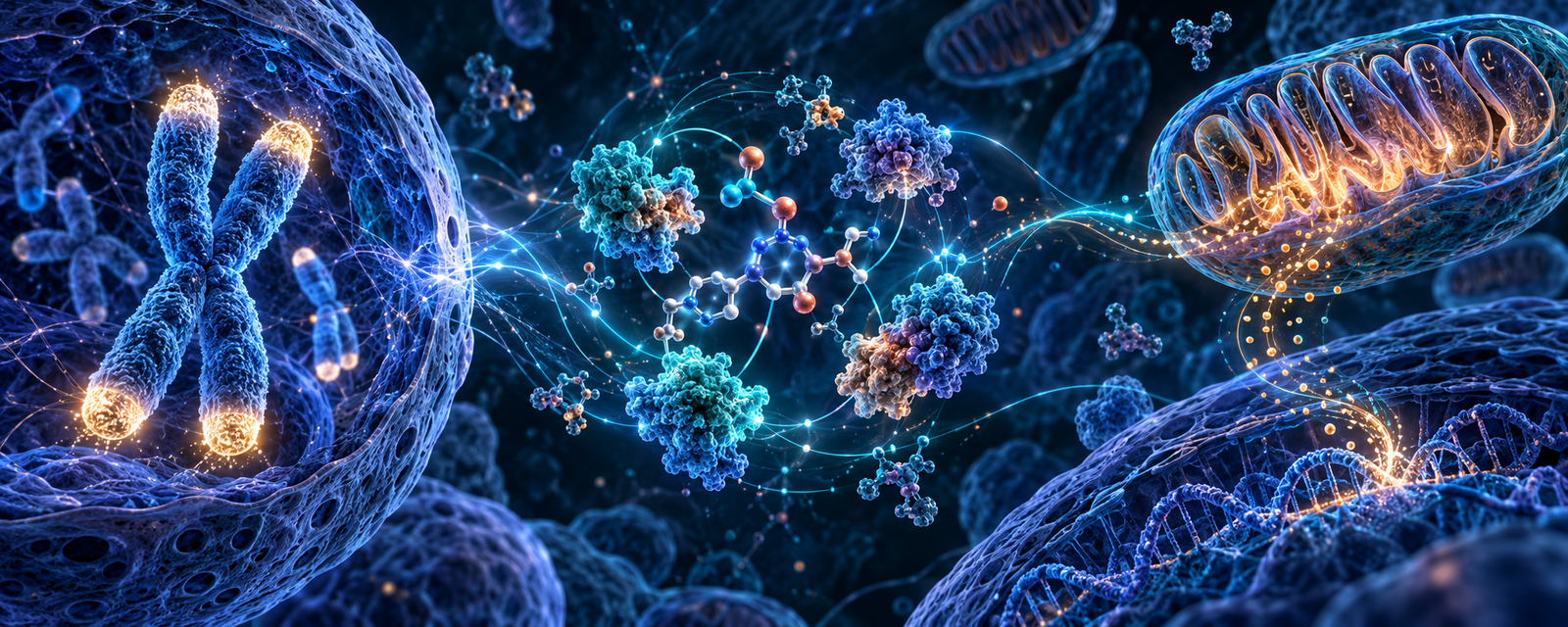
Epithalon, NAD+, and MOTS-C are often grouped under aging or longevity research, but they represent three different biological questions. Epithalon is studied in connection with chromosome-end protection. NAD+ is a cellular cofactor used for energy transfer, DNA repair, and enzyme activity. MOTS-C is a mitochondrial-derived peptide studied as a stress signal.
Comparing them as if they were competing versions of the same mechanism hides the useful differences. A stronger comparison begins with the system being measured: telomere regulation, NAD-dependent chemistry, or communication between mitochondria and the nucleus.
The short comparison
| Epithalon | NAD+ | MOTS-C | |
|---|---|---|---|
| What it is | A four-amino-acid synthetic peptide | A cellular cofactor and electron carrier | A peptide encoded by mitochondrial DNA |
| Main research question | Can a short peptide influence telomerase and telomere-related regulation? | How does the cell supply energy, repair, and signaling enzymes with a shared chemical resource? | How do mitochondria send adaptive stress messages to the nucleus? |
| Primary location of interest | Chromosome ends and nuclear regulation | Nucleus, cytoplasm, and mitochondria | Mitochondria-to-nucleus communication |
| Common measurements | Telomere length, hTERT, telomerase activity, chromosome stability | NAD+/NADH, PARPs, sirtuins, CD38, DNA-damage and energy markers | AMPK, nuclear gene activity, metabolic flexibility, stress responses |
Epithalon starts with chromosome ends
Telomeres are repeated DNA and protective proteins at the ends of chromosomes. They help the cell distinguish a natural chromosome end from broken DNA. Telomerase is the enzyme system that can add new telomere repeats.
Epithalon research has reported changes in hTERT activity, telomerase, and telomere length. The important follow-up questions concern repeatability, the shortest telomeres, chromosome stability, and whether normal controls on cell division remain intact.
NAD+ starts with cellular chemistry
NAD+ accepts and delivers electrons during energy metabolism. It is also broken apart by enzymes that coordinate DNA repair, regulate proteins, and control signaling. This means NAD+ is both a reusable electron carrier and a consumable ingredient.
The research problem is supply and demand. Cells must make and recycle NAD+ while PARPs, sirtuins, CD38, and other enzymes use it. A total NAD+ measurement is helpful, but it becomes more informative when paired with NADH, location, turnover, and enzyme activity.
MOTS-C starts with mitochondrial communication
MOTS-C is encoded by mitochondrial DNA and is studied as part of retrograde signaling—communication that travels from mitochondria back to the nucleus. Under stress, the peptide has been connected with AMPK and changes in genes involved in adaptation.
This is not the same as directly carrying electrons or maintaining a chromosome end. MOTS-C research asks how an energy-producing structure reports its condition and influences the rest of the cell.
Where the three systems connect
The mechanisms are distinct, but aging biology links them. DNA damage can increase NAD+ use by PARP enzymes. A changing NAD+ supply can affect metabolic and gene-regulating enzymes. Mitochondrial stress can change nuclear gene activity and increase reactive molecules. Telomere dysfunction can activate damage responses and contribute to cellular senescence.
The connection is best understood as a network, not a ranking. Epithalon points toward one part of chromosome maintenance. NAD+ supports reactions used across multiple compartments. MOTS-C carries information about mitochondrial stress. No one measurement replaces the others.
Which comparison fits the question?
- Choose Epithalon-centered measurements when the question concerns telomere length, telomerase regulation, chromosome-end protection, or division limits.
- Choose NAD+-centered measurements when the question concerns electron transfer, cofactor availability, DNA-repair demand, sirtuin activity, or NAD+ recycling.
- Choose MOTS-C-centered measurements when the question concerns mitochondrial stress signaling, AMPK, nuclear adaptation, or metabolic flexibility.
- Combine systems only when the experiment can show the order of events. Measuring everything at once without a pathway model can create correlation without explaining cause.
Key distinctions
| Question | Best starting point | Why |
|---|---|---|
| Did chromosome-end regulation change? | Epithalon | Its research focus is telomerase and telomere-related activity. |
| Did repair activity increase demand for cellular resources? | NAD+ | PARPs and other enzymes consume NAD+ during their reactions. |
| Did mitochondria change the cell’s stress-response program? | MOTS-C | It is studied as a signal from mitochondria to the nucleus. |
| Did the complete aging process reverse? | None alone | Aging includes many linked systems and cannot be established from one pathway. |
Common questions
Is NAD+ a peptide?
No. NAD+ is a cofactor made from nucleotide-related components. Epithalon and MOTS-C are peptides, which are short chains of amino acids.
Do all three act in the nucleus?
The nucleus is relevant to all three, but in different ways. Epithalon research examines regulation related to chromosome ends. Nuclear enzymes consume NAD+. MOTS-C can participate in mitochondrial-to-nuclear stress signaling.
Can one marker prove a longevity effect?
No. Telomere length, NAD+ concentration, or AMPK activity each describes part of a system. Useful interpretation requires function, timing, location, and related measurements.
Research products
Return to the Regeneration, Aging & Longevity Research area for the broader framework.
References
- Hallmarks of aging: an expanding universe
- Epitalon and telomere-related activity
- Roles of NAD+ in health and aging
- NAD+ and maintenance of DNA integrity
- MOTS-C, stress, metabolism, and aging
Research and educational content only. CellTek products are not for human or veterinary use.
