
Dermal, Follicular & Tissue Research
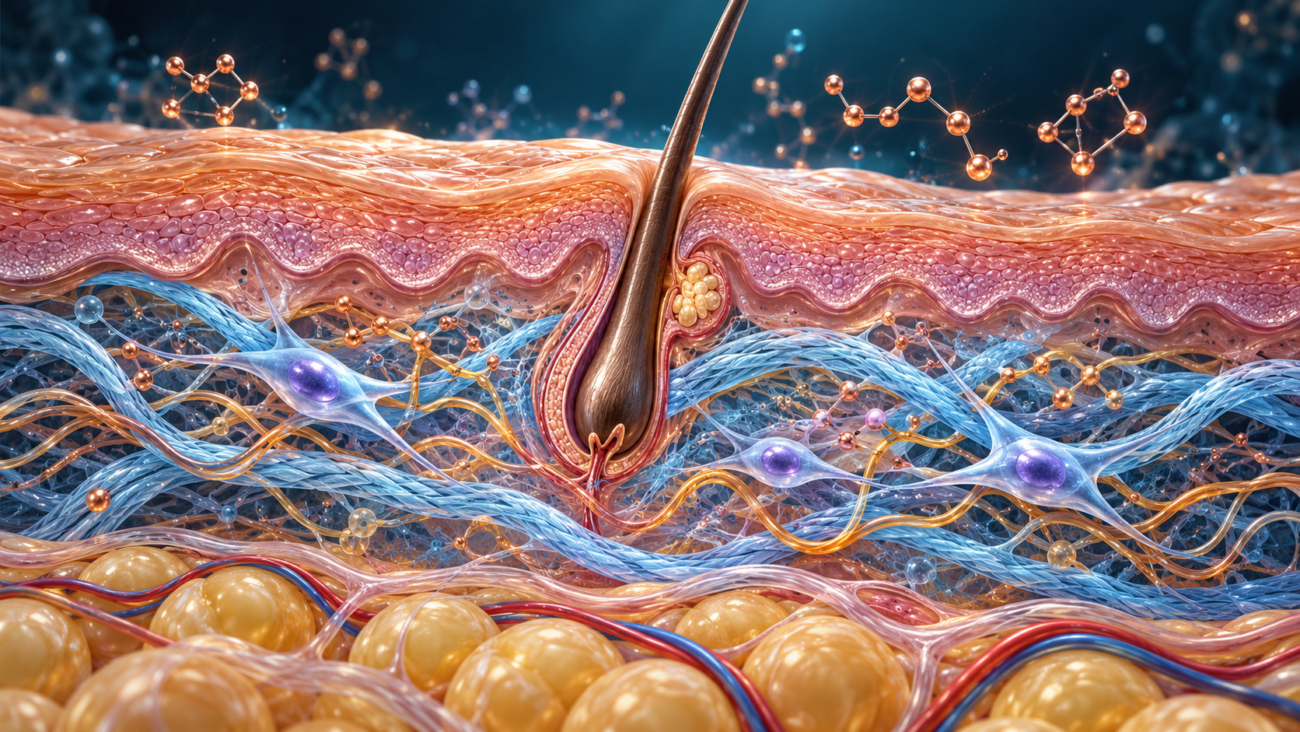
Skin and hair follicles are active tissues, not passive coverings. Their cells constantly replace old material, respond to stress, communicate with immune signals, and rebuild the supporting matrix around them. Peptide research in this area follows several different questions: how cells make collagen, how follicles move through growth and rest cycles, how pigment-producing cells respond to melanocortin signals, and how short peptides can change communication at the cell surface.
The three systems behind this research area
- Dermal matrix remodeling: fibroblasts (cells that build connective tissue) make and reorganize collagen, elastin, and other material that gives skin structure.
- Follicle cycling: a hair follicle shifts between active growth, transition, rest, and release. Stem-cell movement, local blood-vessel signals, and the matrix around the follicle help control those shifts.
- Pigment and inflammatory signaling: melanocortin receptors receive messages related to pigment production, cellular stress, and immune balance. Closely related peptides can affect different parts of this network.
GHK-Cu and the extracellular matrix
GHK-Cu is a three-amino-acid peptide bound to copper. The peptide helps carry copper into a signaling complex; the copper is not merely decorative. Research connects this complex with fibroblast activity, collagen production, elastin, blood-vessel signals, and matrix metalloproteinases. Matrix metalloproteinases are enzymes that cut and reorganize old structural proteins so tissue can be rebuilt rather than simply layered over.
This matters because healthy remodeling requires both construction and controlled breakdown. Measuring only new collagen would miss half of the process. The article GHK-Cu: Skin Matrix and Tissue Remodeling explains the sequence and the measurements used to study it.
What follicles add to the picture
A follicle is a small organ containing several cell populations. The bulge region holds stem cells that can produce new follicle and skin cells. Dermal papilla cells at the base help coordinate growth signals. Surrounding blood vessels and matrix supply and support the structure. A useful follicle study therefore looks beyond visible hair length and asks whether cells proliferated, avoided premature cell death, migrated to the correct location, or changed the size and stage of the follicle.
Copper-binding peptides and thymosin beta-4–related pathways have both been examined in follicle research, but they enter through different mechanisms. Read GHK-Cu and Hair-Follicle Biology for a focused explanation.
Four different product strategies
GHK-Cu: matrix-centered research
GHK-Cu is the most direct product in this group for studying copper-peptide signaling and matrix remodeling. Its literature spans collagen synthesis, fibroblast behavior, enzyme regulation, vessel formation, and follicle-related measurements.
SNAP-8: vesicle-release research
SNAP-8 (Topical) is not a collagen-building peptide. It is modeled on part of SNAP-25, a protein in the SNARE complex. That complex helps a cell dock a small cargo-filled bubble, called a vesicle, to the cell membrane and release its contents. Researchers use SNAP-8 to ask how partial interference with that docking machinery changes cell-to-cell signaling. See SNAP-8: SNARE Signaling and Vesicle Release.
KPV and Melanotan-2: related origin, different questions
KPV is the final three-amino-acid section of alpha-melanocyte-stimulating hormone, usually shortened to alpha-MSH. Research commonly follows inflammatory signals and keratinocytes, the main cells in the outer skin layer. Melanotan-2 is a cyclic alpha-MSH analog studied primarily for activation of melanocortin receptors and pigment production. The shared family name does not make the compounds interchangeable. KPV vs. Melanotan-2 maps the difference.
GLOW and KLOW: multi-pathway blends
GLOW combines BPC-157, GHK-Cu, and TB-500. KLOW adds KPV to those three components. Blend research can examine overlapping repair, matrix, movement, and inflammatory signals, but it also adds interpretation challenges because a combined result does not reveal which component produced it. The article GLOW vs. KLOW: Peptide Blends Compared shows how to separate those questions.
How the compounds compare
| Compound | Main entry point | Common research measurements |
|---|---|---|
| GHK-Cu | Copper-peptide and matrix signaling | Collagen, elastin, fibroblast activity, matrix enzymes, follicle size |
| SNAP-8 | SNARE-complex assembly | Vesicle docking, membrane fusion, release signaling |
| KPV | Short alpha-MSH-related signaling | NF-kB and MAPK pathways, keratinocyte stress, inflammatory markers |
| Melanotan-2 | Melanocortin receptors | Melanin production, receptor response, pigmentation measures |
| GLOW / KLOW | Several pathways at once | Matrix, migration, vessel, and inflammatory markers |
What makes a finding useful?
A visible change is most useful when it can be connected to a measured pathway. More collagen does not automatically mean the fibers were arranged correctly. A larger follicle does not by itself identify which cell population changed. More pigment shows that melanogenesis—the process that makes melanin—responded, but not which other melanocortin receptors were involved. Strong research combines an outward measurement with cell, protein, or gene-level evidence.
Common questions
Are GHK and GHK-Cu the same?
GHK is the three-amino-acid peptide. GHK-Cu is the complex formed when GHK binds a copper ion. They are closely related, but copper binding changes the chemical and biological questions being studied.
Is hair-follicle research only about faster growth?
No. Researchers also measure which stage a follicle is in, stem-cell movement, dermal papilla activity, programmed cell death, matrix remodeling, and blood-vessel support.
Does KPV cause the same pigment response as Melanotan-2?
No. KPV lacks the central alpha-MSH sequence normally required for strong pigment-receptor activation. Its research is centered more on inflammatory and protective signaling, while Melanotan-2 is studied as a broader melanocortin-receptor agonist.
Can a blend result be assigned to one ingredient?
Not without additional controls. A well-designed comparison tests the blend alongside its individual components or simpler combinations. That makes it possible to distinguish an additive effect from one ingredient dominating the measurement.
Learn More by Product
Choose a product to view its catalog page, then open the related article for a focused explanation of its pathway, key findings, and comparisons.
References
- The human tri-peptide GHK and tissue remodeling (PubMed)
- Tripeptide-copper complex and human hair follicles (PubMed)
- Thymosin beta-4 and hair-follicle stem-cell activity (PubMed)
- Alpha-MSH, KPV, and keratinocyte signaling (PubMed)
- Melanotan-II and pigmentation measurements (PubMed)
For research and educational purposes only. Not for human or animal consumption.
