
KPV vs. Melanotan-2: Melanocortin Research Compared
Research Area: Dermal, Follicular & Tissue Research
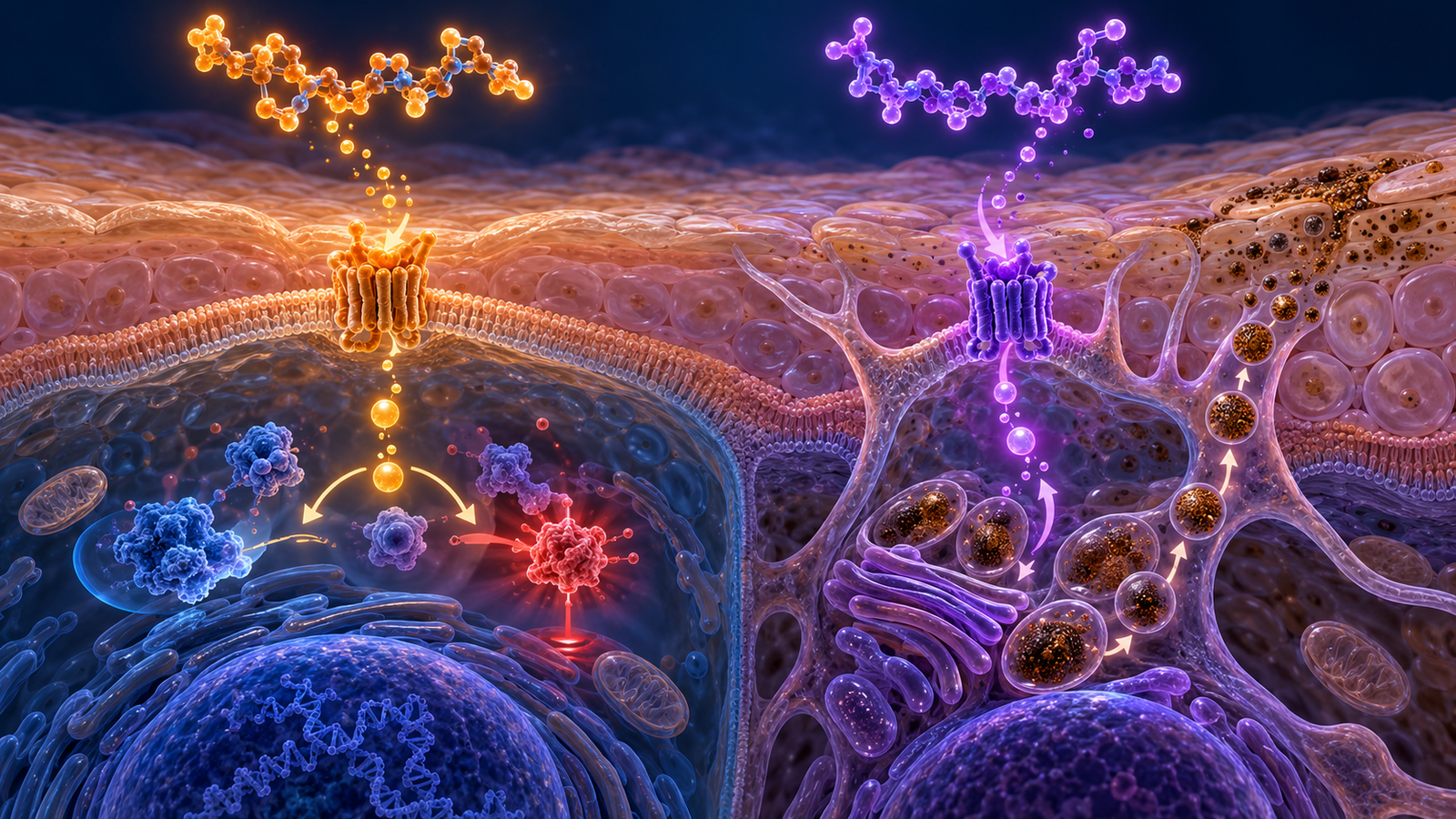
KPV and Melanotan-2 both trace back to alpha-melanocyte-stimulating hormone, commonly written as alpha-MSH. That shared origin can be misleading. KPV is a three-amino-acid tail fragment studied mainly for inflammatory and protective signaling. Melanotan-2 is a cyclic analog designed to activate several melanocortin receptors and is studied prominently in pigment biology. They answer different research questions.
Start with alpha-MSH
Alpha-MSH is a natural signaling peptide made from a larger precursor protein. It can bind melanocortin receptors, a family of five related receivers called MC1R through MC5R. MC1R is especially important in melanocytes, the cells that make melanin pigment. Other receptor family members participate in energy balance, endocrine signaling, and additional functions.
Melanotan-2: receptor activation and melanogenesis
Melanotan-2 is a ring-shaped, or cyclic, analog of alpha-MSH. Its structure helps it bind melanocortin receptors. When MC1R is activated in a melanocyte, intracellular cyclic AMP can rise. Cyclic AMP is a small messenger that carries a signal inside the cell. This can increase activity of pigment-related genes and enzymes, leading to melanogenesis—the production of melanin.
Because Melanotan-2 is not selective for only MC1R, research findings may include signals from other melanocortin receptors. A pigmentation measurement confirms an outward response but does not map every receptor involved.
KPV: a short fragment with a different profile
KPV is lysine-proline-valine, the final three amino acids of alpha-MSH. It does not contain the central sequence normally associated with strong melanocortin-receptor activation and pigment production. Its research instead follows inflammatory pathways such as NF-kB and MAPK. These are internal relay systems that change which genes a cell turns on after stress or immune signals.
Keratinocytes—the main cells in the outer skin layer—can release inflammatory messengers when stressed. KPV studies have examined changes in those messengers, oxidative stress, and cell survival. The key comparison with Melanotan-2 is therefore not which peptide is “stronger,” but which pathway and outcome a study is designed to measure.
Side-by-side comparison
| Feature | KPV | Melanotan-2 |
|---|---|---|
| Structure | Three-amino-acid linear fragment | Cyclic alpha-MSH analog |
| Main research focus | Inflammatory and protective signaling | Melanocortin-receptor activation and pigmentation |
| Typical cells | Keratinocytes and immune-related models | Melanocytes and receptor-expression models |
| Common measurements | Cytokines, NF-kB, MAPK, oxidative stress | Melanin, cyclic AMP, receptor response, reflectance |
| Pigment response | Not the central expected action | A central research outcome |
What study controls matter?
For KPV, researchers need a defined inflammatory or stress signal, an untreated comparison, and measurements before and after the peptide is added. For Melanotan-2, receptor identity matters. Using cells with a known receptor profile or blocking a receptor can show which receiver carries the signal. Time also matters because gene activation, enzyme activity, and visible pigment change occur on different schedules.
Common questions
Does every alpha-MSH fragment cause pigmentation?
No. Receptor binding depends on the exact sequence and shape. KPV preserves anti-inflammatory activity reported for alpha-MSH-related peptides but lacks the central pigment-activating sequence.
Is Melanotan-2 selective for MC1R?
No. It is generally described as a nonselective melanocortin-receptor agonist, meaning it can activate more than one receptor in the family.
Can a pigment measurement identify the receptor?
Not by itself. Pigment shows that melanogenesis changed. Receptor-blocking experiments, binding measurements, or cells with defined receptors are needed to identify the path.
Why is KPV included in KLOW?
KLOW adds KPV to the BPC-157, GHK-Cu, and TB-500 combination found in GLOW. That adds a distinct inflammatory-signaling question to a blend already focused on repair, matrix, and cell movement. See GLOW vs. KLOW for the full map.
References
- Alpha-MSH, KPV, and signaling in human keratinocytes (PubMed)
- Alpha-MSH-related tripeptides and inflammatory signaling (PubMed)
- KPV and anti-inflammatory signaling beyond the receptor-binding sequence (PubMed)
- KPV, oxidative stress, and keratinocyte pathways (PubMed)
- MC1R signaling and melanogenesis in human melanocytes (PubMed)
- Melanotan-II pilot study and pigmentation measurements (PubMed)
For research and educational purposes only. Not for human or animal consumption.
