
GLOW vs. KLOW: Peptide Blends Compared
Research Area: Dermal, Follicular & Tissue Research
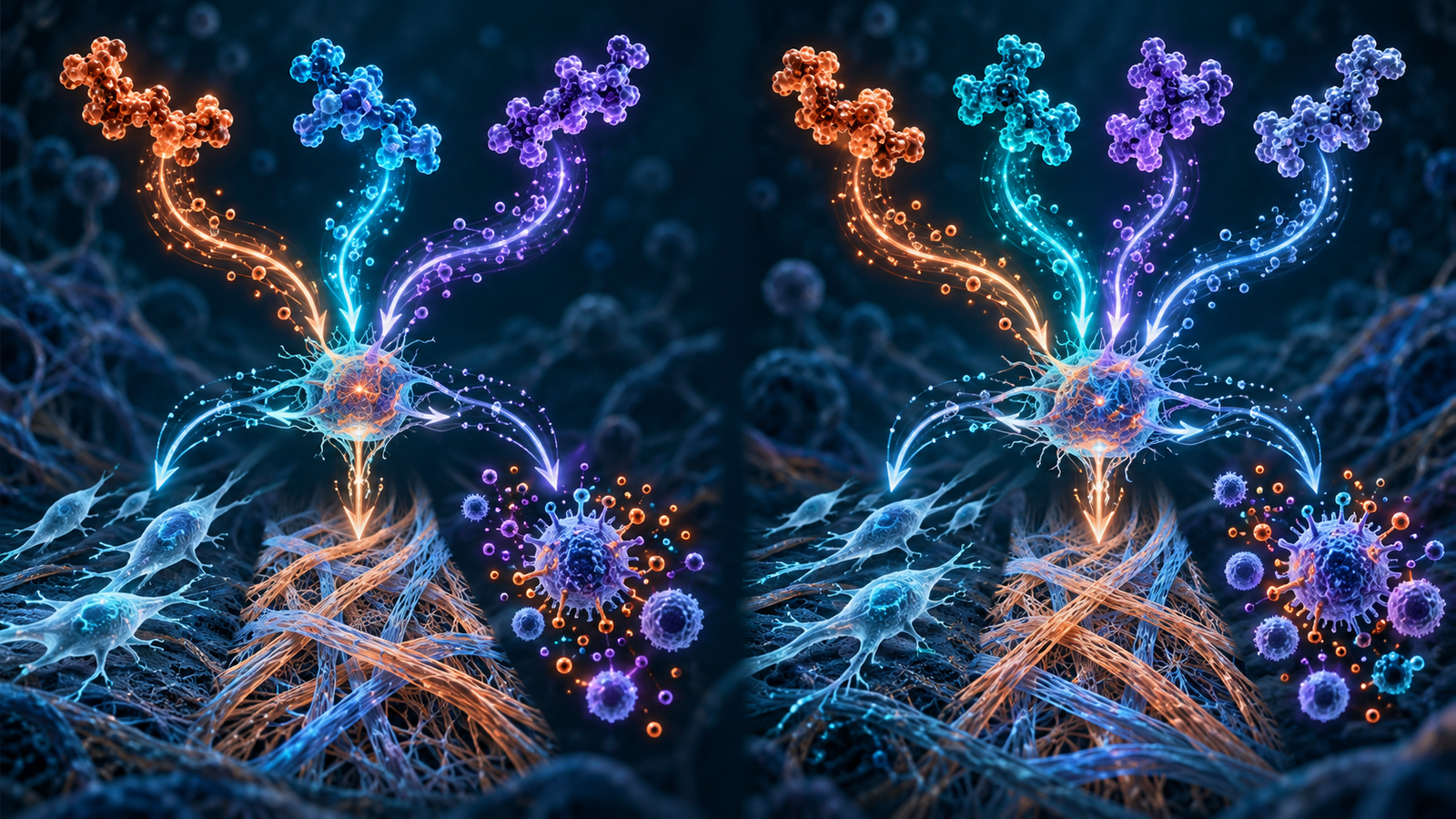
GLOW and KLOW are multi-peptide research blends. GLOW combines BPC-157, GHK-Cu, and TB-500. KLOW contains those three components plus KPV. The extra ingredient changes the questions a study can ask, but a blend also makes cause and effect harder to separate.
What each component contributes to the research map
BPC-157: attachment, movement, and vessel-related signals
BPC-157 research includes FAK and paxillin, proteins that help cells attach to their surroundings and move. Studies also follow VEGF-related signaling, which participates in new blood-vessel formation. These measurements place BPC-157 near the migration and early organization stages of a repair model.
GHK-Cu: matrix building and remodeling
GHK-Cu is a copper-binding tripeptide studied for fibroblast activity, collagen, elastin, matrix enzymes, and angiogenic signals. It adds a strong extracellular-matrix question: how old structural material is removed and replaced with organized new material. Read GHK-Cu: Skin Matrix and Tissue Remodeling.
TB-500: actin and cell movement
TB-500 is associated with an active region of thymosin beta-4. Thymosin beta-4 binds actin, a structural protein that cells use to hold their shape and move. Full-length thymosin beta-4 research helps form a mechanism hypothesis, but results for the full protein should not be presented as direct proof for every shorter fragment. The distinction is explained in BPC-157 vs. TB-500.
KPV: inflammatory and stress signaling
KPV is the component that separates KLOW from GLOW. It is a three-amino-acid fragment of alpha-MSH studied for inflammatory pathways, including NF-kB and MAPK, and for responses to oxidative stress. It adds a way to ask whether inflammatory signaling changes alongside movement and matrix measurements. See KPV vs. Melanotan-2 for its place in the alpha-MSH family.
GLOW and KLOW side by side
| Research feature | GLOW | KLOW |
|---|---|---|
| BPC-157 | Included | Included |
| GHK-Cu | Included | Included |
| TB-500 | Included | Included |
| KPV | Not included | Included |
| Distinct added question | Three-pathway repair and matrix model | Whether KPV changes inflammatory or stress markers within that model |
What “synergy” actually requires
Synergy means a combination produces more than the sum of the effects produced by its parts. It is not a synonym for “several ingredients were mixed together.” To demonstrate synergy, a study needs the blend, each individual component, and often simpler two- or three-component combinations tested under the same conditions. The measured blend effect is then compared with the effect predicted from the components.
If only the blend is tested, the result can show that the blend produced a change. It cannot show whether one component dominated, whether two components added their separate effects, or whether true synergy occurred.
A practical comparison design
- Choose one primary outcome, such as cell migration or collagen production.
- Use an untreated control and matched concentrations for the relevant individual components.
- Test GLOW and KLOW under the same timing and measurement conditions.
- Measure a KPV-linked signal, such as NF-kB activity, to test what the fourth component changes.
- Repeat the study with a second outcome to determine whether the result is pathway-specific.
Common questions
Is KLOW simply a stronger GLOW?
No. KLOW contains an additional peptide with a different research focus. “Stronger” is meaningless without naming the outcome. KLOW could differ on an inflammatory marker while matching GLOW on a matrix measurement.
Can a blend be used to identify a mechanism?
It can contribute to a mechanism study, but individual-component controls are necessary. Without them, the blend result cannot identify which pathway caused the change.
Do overlapping pathways guarantee a larger result?
No. Overlap can produce addition, synergy, no extra change, or even interference. Receptor limits, timing, concentration, and feedback signals can all alter the combined response.
Why cross-link to individual compound articles?
The blend makes sense only when each component’s entry point is clear. Individual articles establish those mechanisms; the blend article explains how to test their interaction.
References
- BPC-157 and FAK-paxillin signaling (PubMed)
- BPC-157 and vessel-related repair signaling (PubMed)
- GHK-Cu and tissue remodeling (PubMed)
- Thymosin beta-4 active regions and repair signaling (PubMed)
- Thymosin beta-4 actin-binding region and angiogenesis (PubMed)
- KPV and inflammatory signaling (PubMed)
For research and educational purposes only. Not for human or animal consumption.
