
Single, Dual, Triple, and Amylin Signaling: How the GLP Research Compounds Differ
Research Area: Metabolic Signaling Research
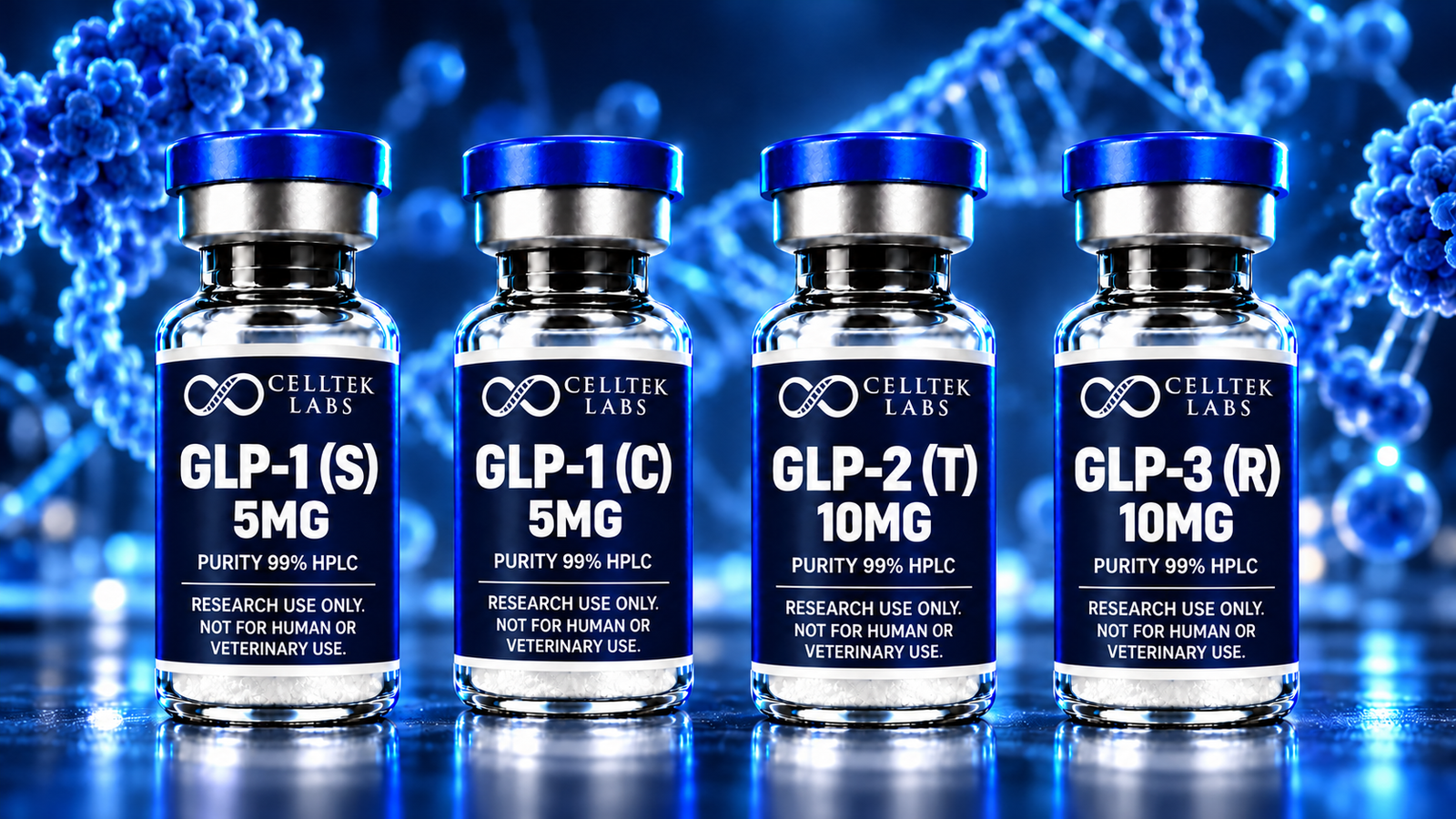
GLP-1 (S), GLP-1 (C), GLP-2 (T), and GLP-3 (R) all belong in metabolic research, but they do not ask the same question. One focuses on the GLP-1 receptor, one follows the amylin pathway, one combines GIP and GLP-1 receptors, and one adds glucagon-receptor activity to that dual pattern.
The most useful comparison is therefore not “which compound is best?” It is “which signaling system matches the question being investigated?” Understanding the receptor pattern makes the differences much easier to follow.
The four signaling designs
| CellTek compound | Primary pathway | What it helps isolate |
|---|---|---|
| GLP-1 (S) | GLP-1 receptor | Sustained activity at one meal-related receptor. |
| GLP-1 (C) | Amylin receptors | A separate fullness and meal-pacing pathway. |
| GLP-2 (T) | GIP and GLP-1 receptors | The interaction between two nutrient-responsive signals. |
| GLP-3 (R) | GIP, GLP-1, and glucagon receptors | What glucagon activity adds to the dual-receptor pattern. |
GLP-1 (S): the single-receptor reference
GLP-1 (S) centers the question on the GLP-1 receptor. This receptor participates in glucose-dependent insulin release, glucagon regulation, digestive pacing, and appetite-related communication between the digestive system and brain.
Because the design focuses on one main receptor family, it provides a useful reference for the multi-receptor compounds. A comparison with GLP-2 (T) asks what changes after GIP activity is added. A comparison with GLP-3 (R) shows the larger difference created by adding both GIP and glucagon activity.
GLP-1 (C): a separate meal-related pathway
GLP-1 (C) follows amylin signaling rather than GLP-1 signaling. Amylin is released alongside insulin and contributes to fullness, the pace at which food leaves the stomach, and glucagon regulation after a meal.
The overlap in measured outcomes makes amylin useful to compare with GLP-1, while the different receptors make the mechanisms distinct. GLP-1 (C) is therefore not another step in a single-dual-triple sequence. It is a parallel pathway that can be studied separately or alongside GLP-1 receptor activity.
GLP-2 (T): two nutrient signals together
GLP-2 (T) combines GIP and GLP-1 receptor activity. Both receptors respond to signals released after nutrients arrive, and both participate in the insulin response. They also differ in receptor distribution and downstream signaling.
The dual design lets researchers investigate an integrated signal delivered by one molecule. Published work has examined glucose regulation, insulin sensitivity, beta-cell function, appetite-related outcomes, body weight, and lipid handling. Beta cells are the pancreatic cells that release insulin.
GLP-3 (R): adding glucagon to the dual pattern
GLP-3 (R) adds glucagon-receptor activity to GIP and GLP-1 signaling. Glucagon helps make stored fuel available and participates in liver metabolism and energy expenditure.
This third pathway changes the research question. Investigators can compare GLP-2 (T) with GLP-3 (R) to examine whether glucagon activity alters glucose-related measures, lipid handling, liver-related outcomes, or energy use. The balance among the three receptor activities is central; triple signaling should not be treated as three identical signals.
Which comparison answers which question?
| Comparison | Question it addresses |
|---|---|
| GLP-1 (S) vs. GLP-1 (C) | How do GLP-1 and amylin pathways reach overlapping meal-related outcomes through different receptors? |
| GLP-1 (S) vs. GLP-2 (T) | What changes when GIP-receptor activity is added to a GLP-1 signal? |
| GLP-2 (T) vs. GLP-3 (R) | What does glucagon-receptor activity add to an existing GIP/GLP-1 pattern? |
| GLP-1 (S) vs. GLP-3 (R) | How does focused GLP-1 activity differ from a broader three-receptor design? |
| GLP-1 (C) with GLP-1 (S) | Do separate amylin and GLP-1 signals produce complementary responses? |
Why more receptors does not automatically mean better
Adding receptor targets increases complexity. It can broaden the response, but it also makes the mechanism harder to separate. A single-receptor design can provide a cleaner answer when the goal is to understand one pathway. A dual or triple design is more useful when the interaction among pathways is the main subject.
Receptor count also says nothing about balance. One compound may activate one target more strongly than another. Duration, amount, receptor preference, and downstream signaling can all change the final pattern.
Measurements that should remain separate
- Receptor activity shows whether a compound begins a signal at a particular target.
- Insulin release measures one pancreatic response to nutrients.
- Insulin sensitivity asks how effectively tissues respond to insulin.
- Digestive pacing concerns how quickly stomach contents move onward.
- Appetite-related measures examine hunger, fullness, food intake, or food-related motivation.
- Energy expenditure measures energy use and is not the same as appetite or food intake.
- Body composition distinguishes changes in fat, lean tissue, and total weight.
A sound comparison holds the measurement steady. If one compound is evaluated by glucose and another by body weight, the study is comparing two outcomes as well as two compounds.
A practical way to choose the starting point
- Start with the outcome that needs to be measured.
- Identify the receptor pathway most directly connected with that outcome.
- Choose the simplest compound that answers the question.
- Add a dual, triple, or parallel pathway only when the interaction itself matters.
- Keep amount, timing, and measurement methods consistent across the comparison.
Common questions
Are all four compounds GLP-1 receptor analogs?
No. GLP-1 (S) acts through the GLP-1 receptor. GLP-2 (T) and GLP-3 (R) include GLP-1 activity as part of broader receptor patterns. GLP-1 (C) is connected primarily with amylin receptors.
Which is the cleanest comparison for GLP-3 (R)?
GLP-2 (T), because the compounds share GIP and GLP-1 activity while GLP-3 (R) adds glucagon-receptor activity.
Why include GLP-1 (C) in the same article?
Amylin and GLP-1 are separate pathways that participate in the response to a meal and influence some of the same measurements. Including GLP-1 (C) prevents overlapping outcomes from being mistaken for identical mechanisms.
Continue exploring metabolic signaling
Return to the Metabolic Signaling Research overview, or continue with a related article:
- GLP-1 (S): receptor signaling and key findings
- GLP-1 (C): amylin signaling and key findings
- GLP-2 (T): dual GIP and GLP-1 receptor research
- GLP-3 (R): triple-receptor metabolic signaling
References
- GLP-1 and energy-balance signaling
- Development of a long-acting amylin analog
- Dual GIP and GLP-1 receptor balance
- Dual-receptor metabolic findings
- Triple GIP, GLP-1, and glucagon receptor research
Explore the related CellTek research products: GLP-1 (S) · GLP-1 (C) · GLP-2 (T) · GLP-3 (R)
Research and educational content only. CellTek products are not for human or veterinary use.
