
GHK-Cu: Skin Matrix and Tissue Remodeling
Research Area: Dermal, Follicular & Tissue Research
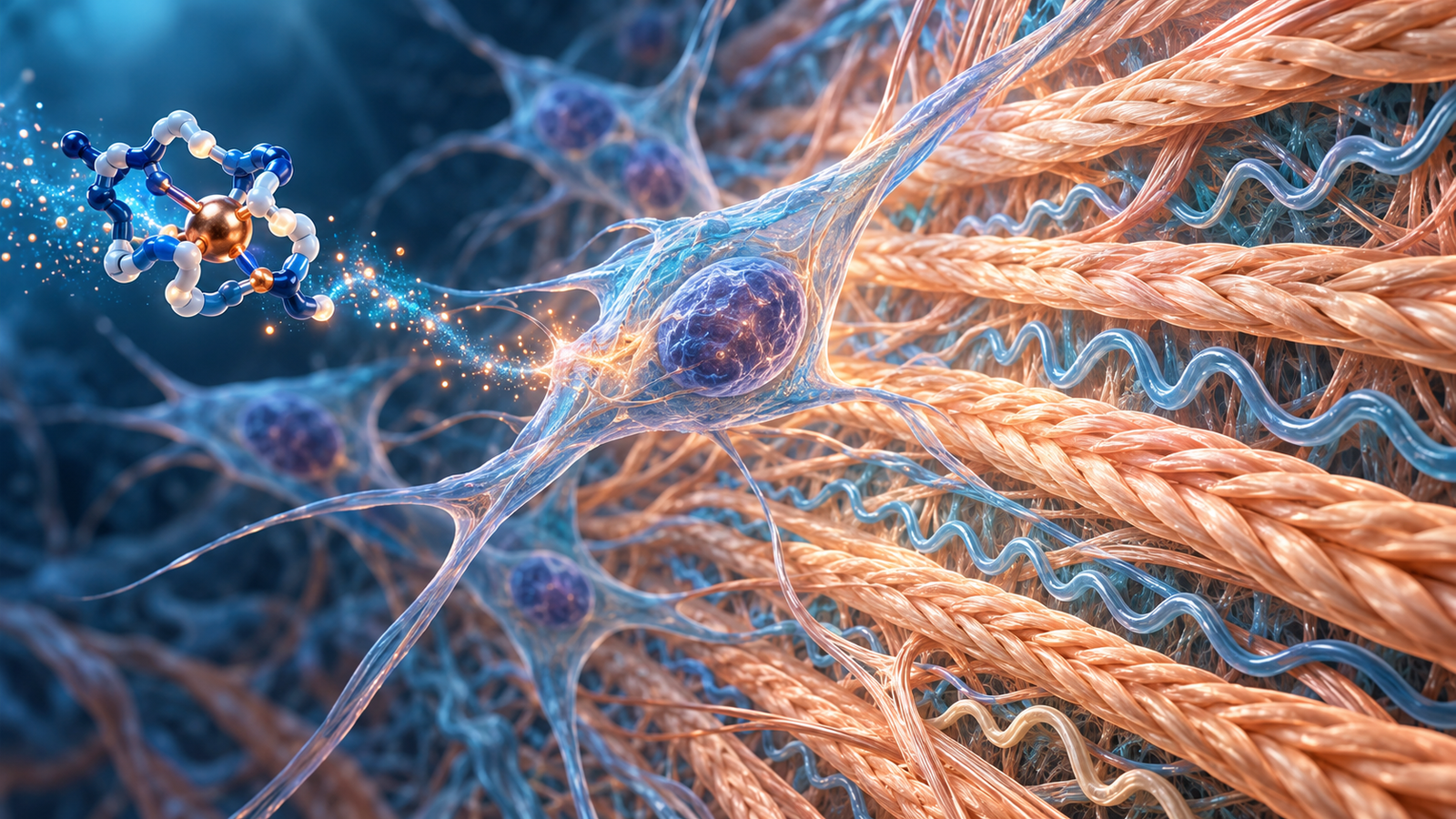
GHK-Cu is made from GHK—a short chain of glycine, histidine, and lysine—bound to a copper ion. That small structure has been studied as a signaling complex involved in tissue remodeling. The central question is not simply whether it “makes collagen.” Researchers ask how it changes the balance between building new structural material, removing damaged material, organizing blood-vessel support, and quieting signals that can keep tissue stuck in an alarm state.
Why copper binding matters
Histidine in the GHK sequence can hold copper in a coordinated chemical structure. Copper is used by many enzymes, including enzymes involved in connective-tissue formation and antioxidant defense. Binding it to GHK changes how the metal is carried and presented to nearby molecules. For that reason, results for the copper complex should not automatically be assigned to unbound GHK, and vice versa.
The matrix is more than collagen
The extracellular matrix is the organized material surrounding cells. Collagen provides tensile strength, meaning resistance to pulling. Elastin helps tissue stretch and return. Glycosaminoglycans are water-binding molecules that contribute to hydration and spacing. Fibroblasts are the cells that build and maintain much of this framework.
GHK-Cu research has reported changes in collagen production and fibroblast activity. It has also examined matrix metalloproteinases, often shortened to MMPs. These enzymes cut matrix proteins. That can sound destructive, but controlled breakdown is necessary: damaged fibers must be removed before a better-organized structure can replace them. A useful study therefore measures both new material and the enzymes that remodel old material.
A step-by-step remodeling model
- Signal: the peptide-copper complex interacts with cells and changes gene or protein activity.
- Cleanup: repair cells and matrix enzymes remove damaged material.
- Construction: fibroblasts increase selected matrix proteins such as collagen or elastin.
- Support: angiogenesis, or new blood-vessel formation, can improve delivery of oxygen and nutrients.
- Organization: fibers and supporting molecules are arranged into functional tissue rather than an unstructured mass.
Measurements that answer different questions
| Measurement | What it shows | What it does not prove alone |
|---|---|---|
| Collagen amount | Whether collagen production or accumulation changed | Whether fibers are correctly aligned |
| Fibroblast proliferation | Whether fibroblast numbers increased | Whether those cells built a balanced matrix |
| MMP activity | Whether matrix-cutting enzymes changed | Whether overall remodeling improved |
| Elastin or glycosaminoglycans | Changes beyond collagen | Final tissue strength or appearance |
| Vessel markers | Whether angiogenic signaling changed | Whether mature, useful vessels formed |
How GHK-Cu differs from repair peptides
GHK-Cu is often grouped with BPC-157 and TB-500 because all three appear in tissue-repair discussions. Their starting points are different. GHK-Cu is centered on copper handling, fibroblasts, and matrix regulation. BPC-157 research commonly follows cell migration and FAK-paxillin signaling, which helps cells attach and move. Thymosin beta-4 research follows actin, a structural protein involved in cell shape and movement. See BPC-157 vs. TB-500: Tissue-Repair Pathways Compared for the complementary pathways.
Common questions
Does more collagen always mean better remodeling?
No. Amount, type, alignment, cross-linking, and controlled removal all matter. Excess or poorly organized collagen can produce a different result from a balanced matrix.
Why do studies measure both MMPs and their inhibitors?
MMPs cut matrix proteins, while tissue inhibitors of metalloproteinases help restrain them. The balance between the two helps determine whether remodeling is controlled or excessive.
Is GHK-Cu research limited to skin appearance?
No. The same matrix, vessel, inflammatory, and repair signals are studied in several tissues. Skin is especially useful because its layers, fibroblasts, and structural proteins can be measured directly.
Where does follicle research fit?
Hair follicles rely on matrix structure, cell movement, and local signaling. The focused article GHK-Cu and Hair-Follicle Biology explains the additional cell types and cycle measurements involved.
References
- GHK-Cu and collagen synthesis in fibroblasts (PubMed)
- GHK-Cu and matrix metalloproteinase-2 expression (PubMed)
- GHK and tissue remodeling (PubMed)
- GHK and cellular pathways in skin regeneration (PubMed)
- Regenerative and protective actions of GHK-Cu (PubMed)
- GHK-Cu, hyaluronic acid, and collagen measurements (PubMed)
For research and educational purposes only. Not for human or animal consumption.
