
GHK-Cu and Hair-Follicle Biology
Research Area: Dermal, Follicular & Tissue Research
A hair follicle is a repeating biological system. It builds a fiber, pauses, reorganizes, and begins again. That cycle depends on several cell groups communicating at the correct time. GHK-Cu and other copper-binding peptides are studied in this setting because matrix remodeling, cell survival, blood-vessel signaling, and the behavior of dermal papilla cells can all influence the follicle.
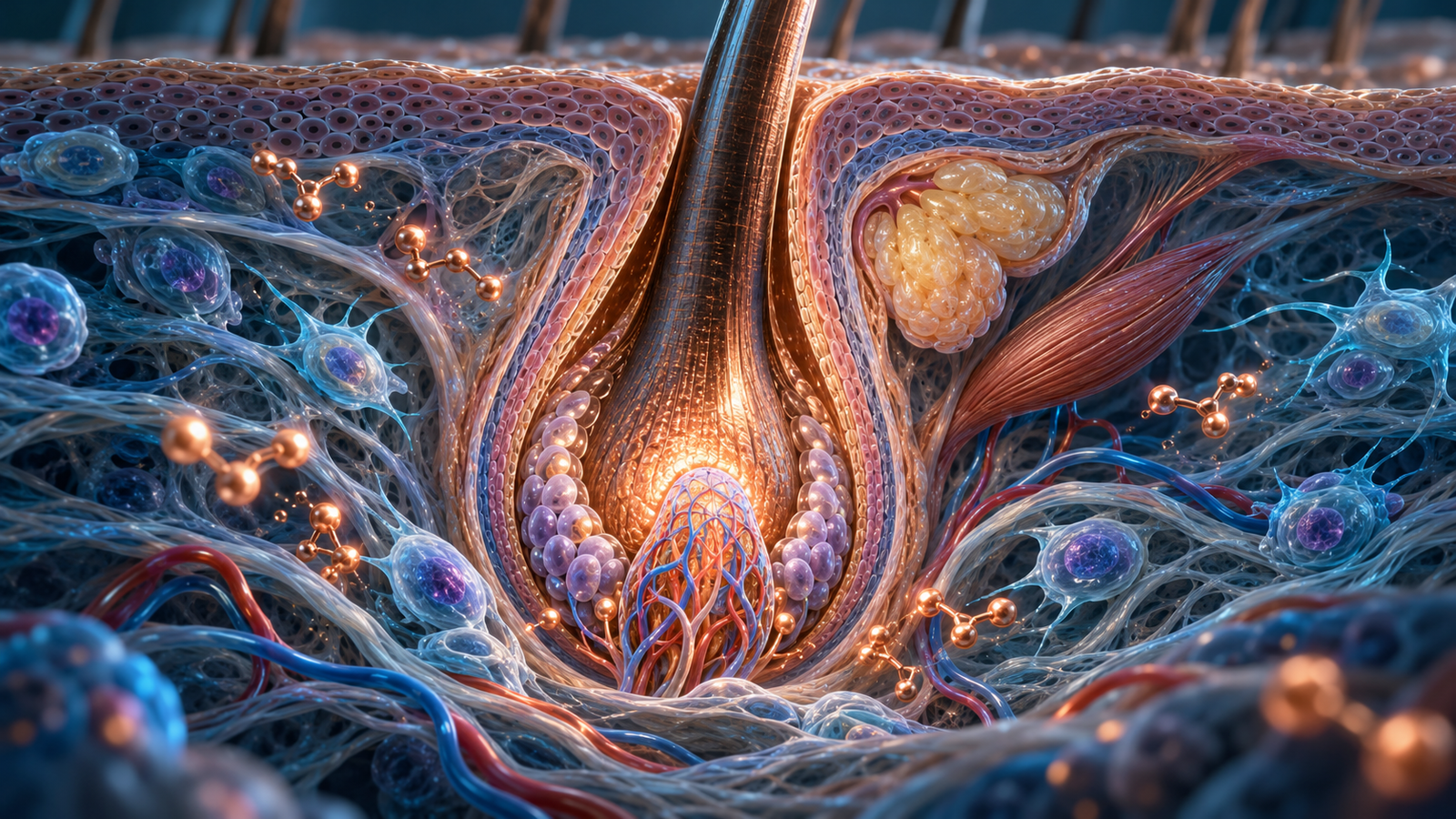
The parts of a follicle that researchers follow
- Dermal papilla: a cluster of cells at the base that sends growth-regulating messages to surrounding follicle cells.
- Matrix cells: rapidly dividing cells that help form the hair shaft.
- Bulge region: a stem-cell niche, meaning a protected location that holds cells able to renew parts of the follicle and skin.
- Outer root sheath: the cell layer surrounding the growing fiber.
- Local matrix and vessels: the support structure and blood supply around the follicle.
Growth is a cycle, not a single switch
Anagen is the active growth stage. Catagen is a controlled transition in which the lower follicle shrinks. Telogen is a resting stage, followed by release and renewed growth. A compound can change follicle size, the percentage of follicles in a stage, cell proliferation, or programmed cell death without affecting every part of the cycle in the same way.
What copper-peptide studies measure
Research on copper-binding peptides has included follicle length, dermal papilla cell proliferation, and apoptosis. Apoptosis means an orderly process by which a cell shuts itself down. A study may therefore ask whether follicle-related cells divide more, remain viable longer, or change the signals they release.
The surrounding matrix also matters. Collagen and other proteins create the physical environment around the follicle. Matrix metalloproteinases reorganize that environment during cycle changes. GHK-Cu is relevant to both construction and remodeling, which is why follicle findings should be read together with its broader matrix research.
GHK-Cu, AHK-Cu, and thymosin beta-4 are not the same tool
| Research compound | Structural distinction | Typical follicle question |
|---|---|---|
| GHK-Cu | Three-amino-acid GHK bound to copper | Matrix remodeling, fibroblast signals, follicle size and tissue support |
| AHK-Cu | A different three-amino-acid copper complex | Dermal papilla proliferation and cell survival |
| Thymosin beta-4 | A 43-amino-acid actin-binding protein | Stem-cell migration, differentiation, and matrix-enzyme activity |
Findings for AHK-Cu or full-length thymosin beta-4 can help explain possible mechanisms, but they should not be relabeled as direct findings for GHK-Cu or the TB-500 fragment. Related structures are starting points for comparison, not proof of identical behavior.
How to read a follicle result
Longer follicles in a culture model show that the isolated follicle responded during the observation period. More dermal papilla cells show proliferation. Lower apoptosis shows that fewer cells entered a programmed shutdown pathway. These measurements become more informative when a study also measures the proteins or genes connecting the compound to the outcome.
Visible fiber growth is a later result produced by the entire follicle system. It does not by itself identify whether the change came from stem-cell movement, papilla signaling, matrix remodeling, blood supply, or another step.
Common questions
Does GHK-Cu directly become part of a hair fiber?
No. It is studied as a signaling and copper-binding complex. The hair fiber is mainly keratin, a structural protein made by follicle cells.
Why are dermal papilla cells important?
They sit at a key communication point at the follicle base and release signals that influence nearby cells. Their number, activity, and survival can affect how the follicle moves through its cycle.
Is a larger follicle automatically a stronger follicle?
No. Size is one useful measurement. Fiber structure, cycle stage, cell organization, matrix support, and long-term repeatability answer different questions.
How does this connect to skin remodeling?
Follicles sit inside skin and share its matrix, immune signals, and blood supply. Read GHK-Cu: Skin Matrix and Tissue Remodeling for the supporting biology.
References
- Tripeptide-copper complex and human hair growth in vitro (PubMed)
- Copper-binding peptide and follicle measurements (PubMed)
- Thymosin beta-4 and hair-follicle stem cells (PubMed)
- Thymosin beta-4, migration, and follicle differentiation (PubMed)
- GHK and tissue remodeling (PubMed)
- Thymosin beta-4 and hair-cycle signaling (PubMed)
For research and educational purposes only. Not for human or animal consumption.
