
AOD-9604: Growth-Hormone Fragment and Metabolic Signaling
Research Area: Cellular Growth & Tissue Repair Research
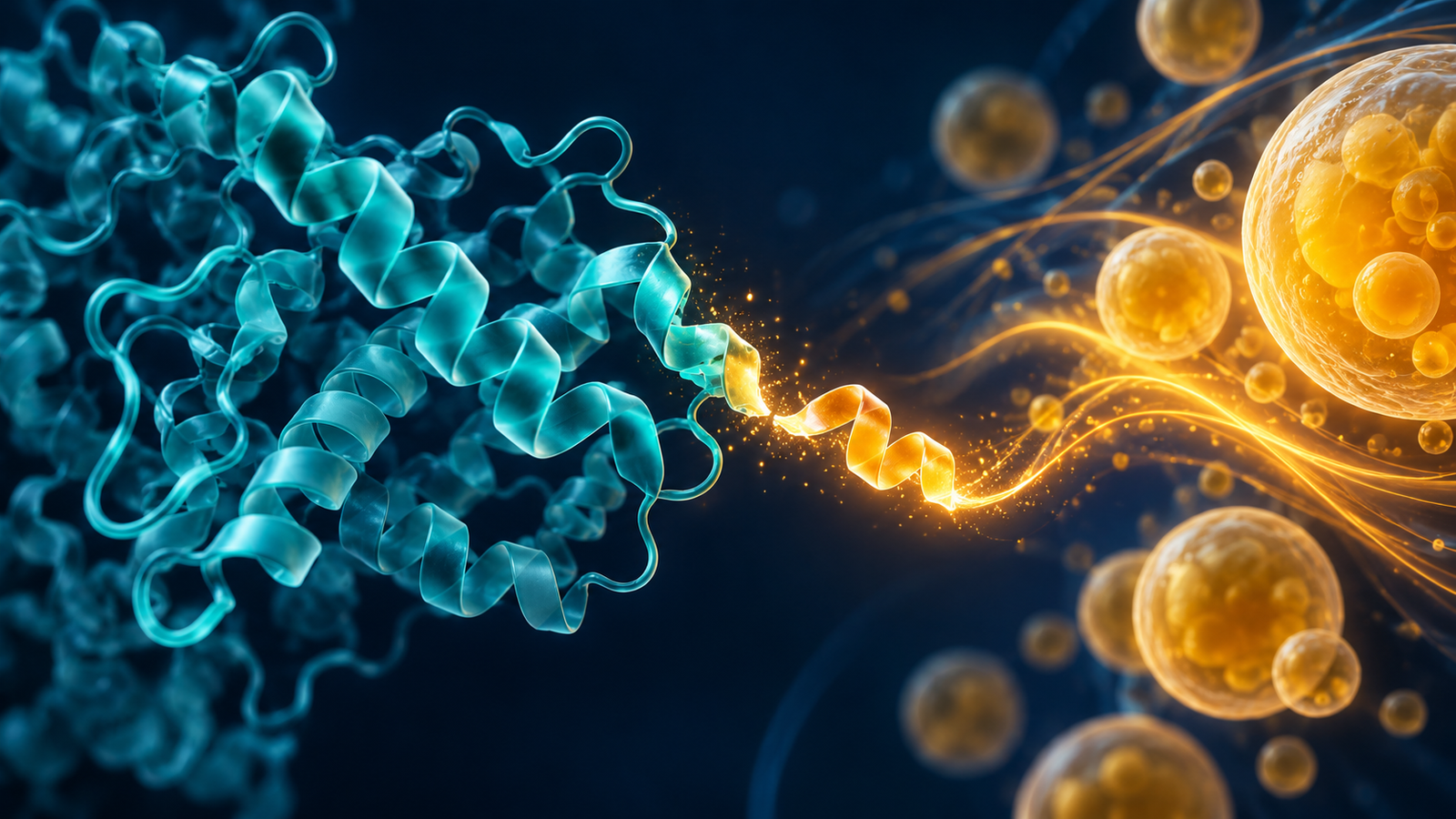
AOD-9604 is a short peptide based on a section near the end of human growth hormone. Researchers developed it to separate one part of growth hormone’s metabolic signaling from the full hormone’s wider growth-related pathway. That design makes AOD-9604 a useful example of how one protein can contain regions with different biological activities.
What AOD-9604 is
Human growth hormone contains 191 amino acids. AOD-9604 is based on amino acids 177 through 191, with an added tyrosine at the beginning. Amino acids are the building blocks of peptides and proteins. The selected region is called the C-terminal fragment because it comes from the end of the hormone’s chain.
Why researchers study a fragment
A large protein can interact with several receptors or pathways through different structural regions. By isolating a shorter section, researchers can ask whether one activity remains while others are reduced or absent. AOD-9604 research has concentrated on lipid metabolism, including lipolysis, the process of breaking stored fat into smaller molecules that can enter energy pathways.
Related work also measures lipogenesis, the process of building and storing fat. The balance between breakdown, storage, energy use, and appetite determines the larger metabolic result. One changed marker does not describe the entire energy-balance system.
Key findings in AOD-9604 research
- Published studies have examined increased fat oxidation and changes in lipid-breakdown signaling.
- Research reported that AOD-9604 did not simply reproduce full growth-hormone receptor signaling.
- Structural studies describe the fragment as a specific functional region within the larger growth-hormone molecule.
- Metabolism research has also examined how quickly the peptide is broken down and how it can be identified analytically.
AOD-9604 compared with HGH
| Feature | AOD-9604 | HGH |
|---|---|---|
| Structure | Short C-terminal fragment | Full 191-amino-acid hormone |
| Main research emphasis | Lipid and energy-balance signaling | Growth-hormone receptor and broad downstream signaling |
| GH receptor relationship | Reported actions are not explained as simple full-receptor activation | Direct growth-hormone receptor ligand |
| Downstream map | Fragment-specific metabolic questions | JAK2, STAT5, IGF-1, and other pathways |
This distinction is why evidence about full growth hormone should not be assigned automatically to AOD-9604, and findings about the fragment should not be treated as proof of the full hormone’s effects.
How metabolic findings are interpreted
Researchers may measure released fatty acids, glycerol, oxygen use, body composition, or enzymes involved in fat storage and breakdown. These measurements occur at different points in the pathway. A rise in a breakdown marker shows mobilization, while oxidation measurements address whether the released material entered energy use.
Structure, receptor activity, and downstream evidence
Fragment research works best when three questions are separated. First, does the fragment keep a stable three-dimensional shape? Second, does it bind the same receptor as the full hormone or act through another route? Third, do downstream metabolic measurements change in a consistent sequence? Structural work, receptor experiments, and metabolic measurements each answer one part.
This approach prevents a common shortcut: assuming that a peptide cut from a larger protein must preserve all of the larger protein’s activities. A fragment may retain one functional region while losing the structures required for other receptor interactions.
Common questions
Is AOD-9604 the same as HGH?
No. AOD-9604 represents a short region of the much larger hormone. The difference in structure changes the pathways researchers expect to observe.
Does lipolysis mean stored fat was used for energy?
Not by itself. Lipolysis releases stored material. Fat oxidation measures a later step in which that material is used in energy-producing pathways.
Product and further reading
View the AOD-9604 product page, read the growth-hormone signaling guide, or return to Cellular Growth & Tissue Repair Research.
References
- Metabolic studies of AOD-9604 (PubMed)
- Fat oxidation and energy balance with the GH fragment (PubMed)
- AOD-9604 and lipid-metabolism signaling (PubMed)
- Structure and biological analysis of the C-terminal fragment (PubMed)
- Detection and metabolism of AOD-9604 (PubMed)
For research and educational purposes only. Not for human or animal consumption.
