
DSIP: Sleep-Wake Signaling, EEG Rhythms, and Stress Biology
Research Area: Neuroscience & Cognition Research
DSIP stands for delta sleep-inducing peptide, a small naturally occurring peptide first connected with slow-wave sleep. Decades of research have examined its relationship with sleep stages, electrical brain rhythms, stress responses, and other regulatory systems. The result is a more complicated story than its name suggests.
What is DSIP?
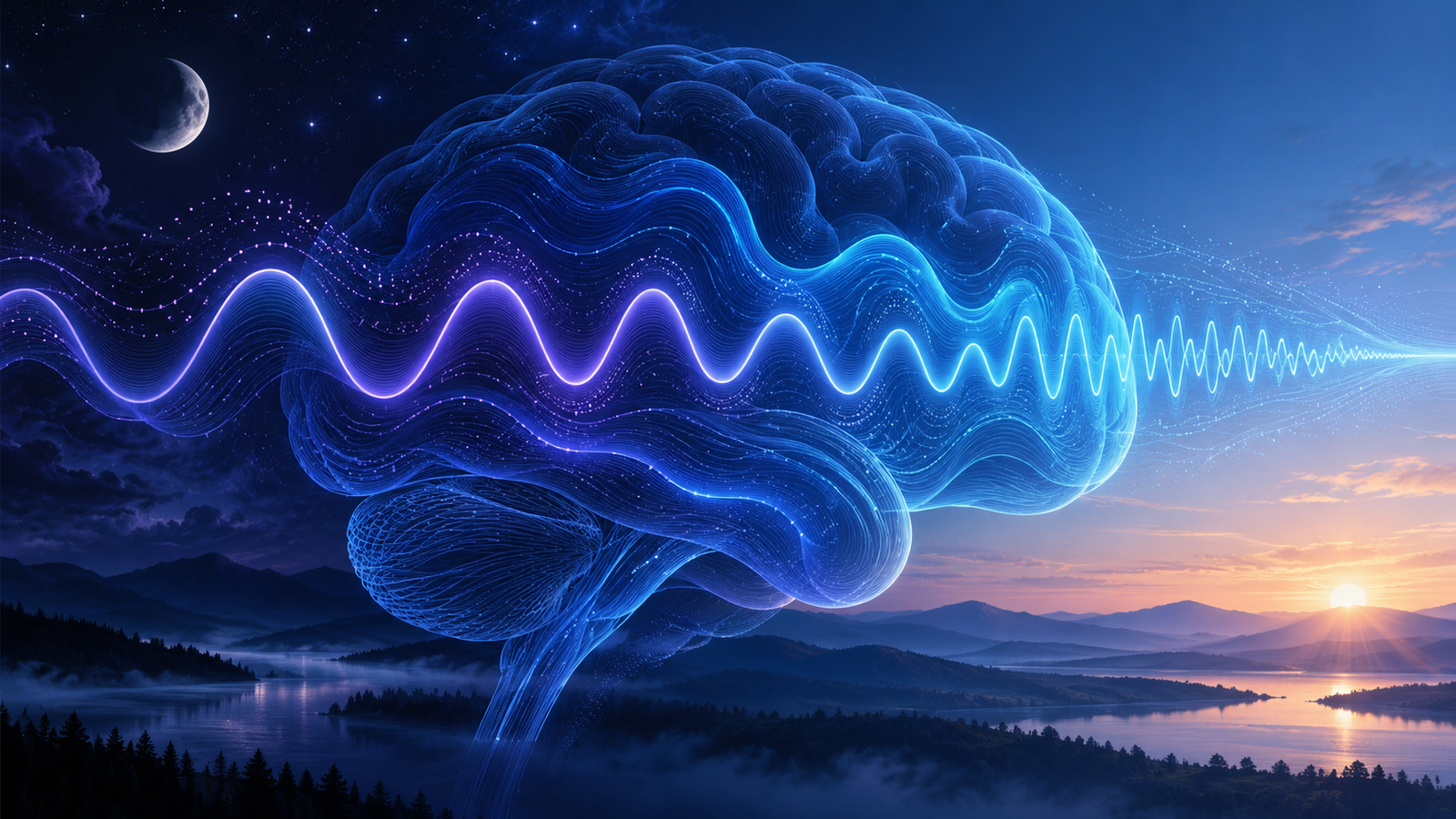
DSIP is a nine-amino-acid peptide identified during experiments involving sleep-related brain activity. “Delta” refers to slow electrical waves that are prominent during deep non-REM sleep. Non-REM means the stages of sleep outside rapid eye movement sleep.
The original name describes the observation that led to study, not a complete biological definition. Later work connected DSIP with several systems and produced results that did not always follow one simple pattern. Scientific reviews have therefore treated DSIP as an unresolved regulatory peptide rather than a single-purpose sleep signal.
How sleep is measured
Researchers divide sleep into stages using an EEG, or electroencephalogram. An EEG records patterns of electrical activity from the brain. Slow delta waves are associated with deep non-REM sleep, while faster patterns appear during lighter sleep and wakefulness. Eye movement and muscle activity are often measured at the same time to distinguish the stages more accurately.
A sleep-related compound might change the time needed to enter a stage, the amount of time spent there, the number of awakenings, or the shape of the electrical rhythm. These are different measurements and should not be collapsed into the single phrase “improves sleep.”
Key findings and open questions
- Early research connected DSIP with the onset and organization of sleep-related electrical patterns.
- Later work examined stress responses, pain signaling, hormone regulation, and other functions beyond sleep.
- Reviews have emphasized that DSIP’s receptor, normal physiological role, and consistent pattern of action remain incompletely defined.
A receptor is the protein that receives a chemical message. Identifying a receptor lets researchers map where a signal can act and which internal pathways it activates. When that map is incomplete, researchers rely on patterns across electrical, biochemical, and behavioral measurements.
Sleep and stress biology overlap
Sleep does not operate separately from the body’s stress system. Stress-related messengers can change alertness, body temperature, hormone timing, and the ability to move between sleep stages. Poor sleep can, in turn, change how those same systems respond the following day.
DSIP research has explored this overlap. The key question is not only whether a sleep measurement changes, but whether that change follows a broader adjustment in the systems that organize daily rhythms and responses to strain.
DSIP compared with other neuroscience peptides
DSIP is set apart by its history in sleep-wake research and the continuing uncertainty around its central mechanism. Semax research commonly follows BDNF and TrkB. Selank research often follows GABA-related signaling. Pinealon research emphasizes gene and oxidative signaling. The neuroscience comparison article puts those questions side by side.
Why sleep timing matters
Sleep is shaped by two overlapping systems. One builds pressure to sleep as time awake increases. The other is the circadian clock, the roughly 24-hour timing system that coordinates alertness, hormones, temperature, and other daily rhythms. A sleep measurement can change because one system shifted, because the two became better aligned, or because another stress signal interrupted them.
This is why investigators record both timing and structure. Falling asleep sooner, spending more time in a stage, and having fewer interruptions are separate outcomes. DSIP’s research history touches several of them, which helps explain why one simple description has been difficult to maintain.
Common questions
Does the name prove that DSIP induces sleep?
No. The name reflects its discovery history. The later literature is mixed and spans more than sleep, which is why the peptide’s exact role remains a research question.
What are delta waves?
Delta waves are slow, high-amplitude electrical patterns most strongly associated with deep non-REM sleep. They are one part of a full sleep recording and do not by themselves describe sleep quality.
Why has DSIP been difficult to define?
Reported effects vary with timing, conditions, and the outcome measured. The absence of a fully established receptor pathway also makes it harder to connect each observation to one molecular explanation.
Explore DSIP and related research
View the DSIP product page or return to Neuroscience & Cognition Research.
References
- Delta sleep-inducing peptide review (PubMed)
- DSIP as an unresolved biological signal (PubMed)
- DSIP and sleep-onset mechanisms (PubMed)
- DSIP research update (PubMed)
- Biochemical regulation of non-REM sleep (PubMed)
For research and educational purposes only. Not for human or animal consumption.
