
ARA-290: The Innate Repair Receptor and Tissue-Protective Signaling
Research Area: Immune & Inflammatory Signaling Research
ARA-290, also known as cibinetide, is an 11-amino-acid peptide designed from the three-dimensional structure of erythropoietin. Erythropoietin is best known for signaling the production of red blood cells, but stressed tissues can use a different receptor combination connected with protection and repair.
ARA-290 was developed to study that second pathway without strongly activating the blood-cell-producing pathway. Its research centers on the innate repair receptor, inflammatory signaling, cell survival, and tissue responses after stress.
One parent molecule can signal through different receptor pairs
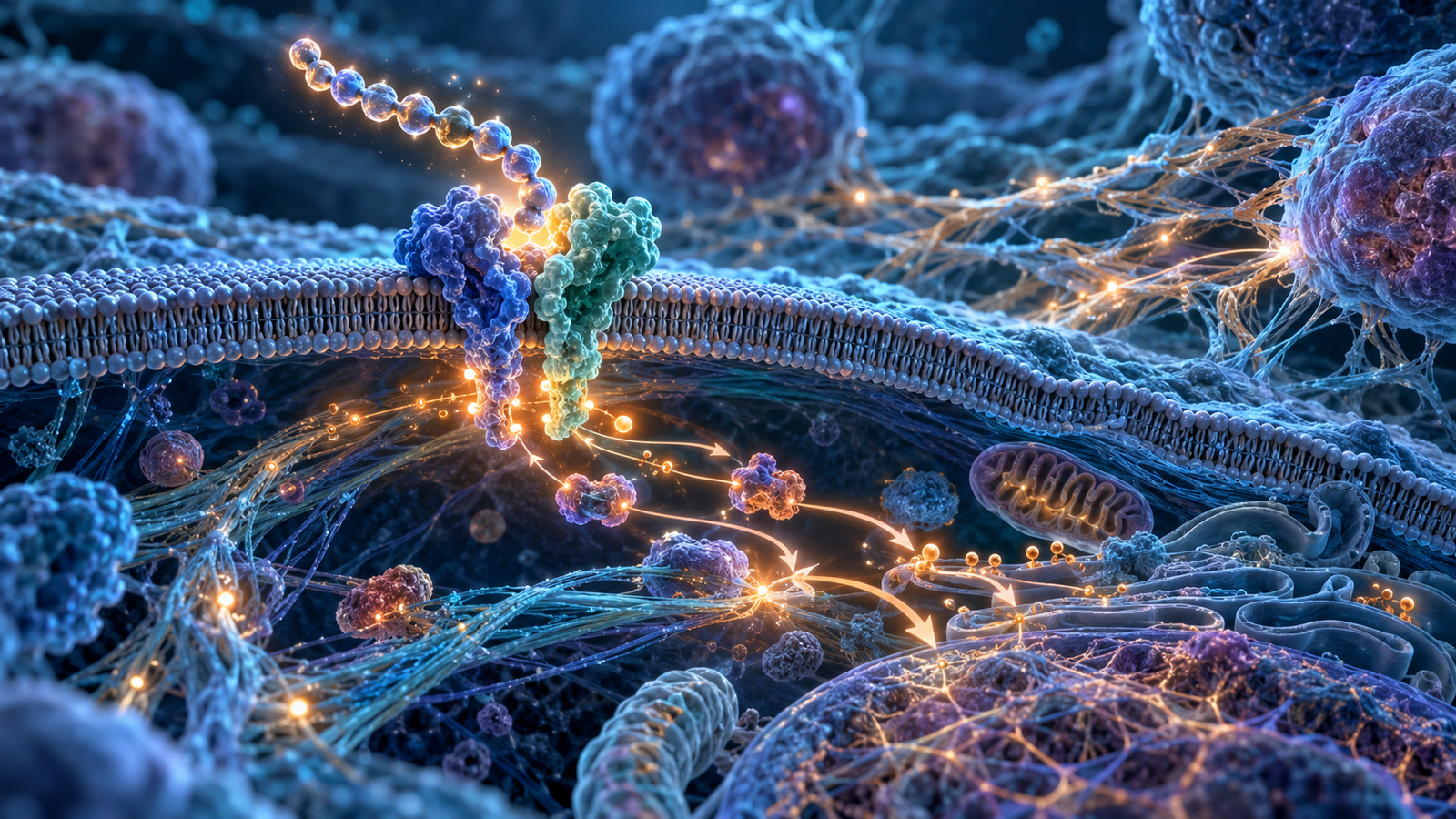
A receptor can be built from more than one protein subunit. The receptor associated with red-blood-cell production uses two matching erythropoietin receptor subunits. The innate repair receptor uses one erythropoietin receptor subunit paired with the beta common receptor, also called CD131.
Changing the receptor pair changes the biological question. The red-blood-cell receptor is associated with survival and development of red-cell precursors. The EPOR/CD131 pair appears in stressed tissue and is studied for signaling related to inflammation, protection, and repair.
ARA-290 is designed around structure, not the full hormone sequence
ARA-290 is based on the surface shape of helix B, one region of erythropoietin. It does not reproduce the full hormone. The design goal is selective interaction with the innate repair receptor while limiting activity at the receptor that drives red-blood-cell production.
This makes receptor selectivity a central measurement. Researchers need to show not only that a downstream marker changed, but that the EPOR/CD131 pathway was involved and that blood-cell-related signaling remained separate.
The innate repair receptor appears during stress
Healthy, resting tissue may express little of the paired receptor. Cellular stress, injury signals, or metabolic disruption can increase its availability. That timing gives the receptor a different role from receptors that continuously manage normal cell activity.
Researchers examine when the receptor appears, which cells express it, and how long it remains. They may then measure signaling proteins, inflammatory cytokines, oxidative stress, programmed cell death, tissue structure, and repair-related behavior.
Tissue protection and tissue repair are related but not identical
Tissue protection means limiting additional damage during or shortly after stress. This might involve changes in inflammatory signaling, oxidative stress, blood flow, or programmed cell death. Repair refers to the later rebuilding and reorganization needed to restore tissue function.
A signal can reduce early damage without completing repair. A strong experiment separates these stages and uses timing that shows whether the measured outcome reflects immediate protection, later rebuilding, or both.
Inflammatory signaling is one part of the pathway
Stressed tissue releases signals that recruit immune cells and change local cell behavior. ARA-290 research has examined whether innate repair receptor signaling changes cytokines, NF-κB-related pathways, immune-cell activity, and oxidative stress.
These markers should be paired with a tissue-level measurement. Lower inflammatory signaling does not automatically mean the tissue recovered. Structure, barrier function, nerve-fiber measurements, cell survival, or another outcome relevant to the tissue must provide the second part of the answer.
Key findings to understand
- ARA-290 is an engineered peptide, not full erythropoietin. Its design is based on the surface structure of erythropoietin’s helix B region.
- The innate repair receptor is a paired receptor. It combines an erythropoietin receptor subunit with CD131, the beta common receptor.
- The target pathway is distinct from red-blood-cell production. Receptor selectivity is therefore a necessary part of the research question.
- Stress and timing affect receptor availability. Researchers need to identify when and where the receptor appears.
- Protection and repair require different measurements. Early signaling changes should not be mistaken for completed tissue restoration.
Measurements that answer different questions
| Measurement | What it helps answer |
|---|---|
| EPOR/CD131 expression | Whether stressed cells display the innate repair receptor components |
| Receptor-pathway activity | Whether the paired receptor carried a signal into the cell |
| Cytokines and NF-κB markers | Whether inflammatory communication changed |
| Oxidative-stress markers | Whether reactive-molecule balance changed |
| Apoptosis markers | Whether signals connected with programmed cell death changed |
| Tissue structure or function | Whether molecular changes were accompanied by a meaningful local outcome |
| Blood-cell pathway controls | Whether the intended signaling remained separate from erythropoiesis |
How ARA-290 differs from Thymosin Alpha-1 and KPV
ARA-290 centers on a stress-induced tissue receptor. Thymosin Alpha-1 centers on communication between innate recognition, dendritic cells, and T cells. KPV centers on NF-κB-related inflammatory signaling and barrier tissues.
See Thymosin Alpha-1 vs. KPV vs. ARA-290: Immune Research Compared, or return to Immune & Inflammatory Signaling Research.
Common questions
Is ARA-290 the same as erythropoietin?
No. It is a short engineered peptide based on one surface region of erythropoietin. It is designed to examine a different receptor combination.
What does non-erythropoietic mean?
It means the peptide is designed not to strongly drive erythropoiesis, the process that produces red blood cells. That allows researchers to separate tissue-protective signaling from the parent hormone’s best-known function.
Does a lower inflammatory marker prove tissue repair?
No. Repair requires structural or functional evidence appropriate to the tissue. The marker explains part of the pathway, not the whole outcome.
Research product
View the CellTek Labs ARA-290 research product.
References
- ARA-290 and the innate repair receptor
- The innate repair receptor in injury and healing
- ARA-290, inflammatory signaling, and the TRPV1 channel
- Cibinetide and EPOR/CD131 signaling in tissue repair
- ARA-290 and nerve-fiber research
Research and educational content only. CellTek products are not for human or veterinary use.
