
Epithalon: Telomeres, Telomerase, and Key Findings
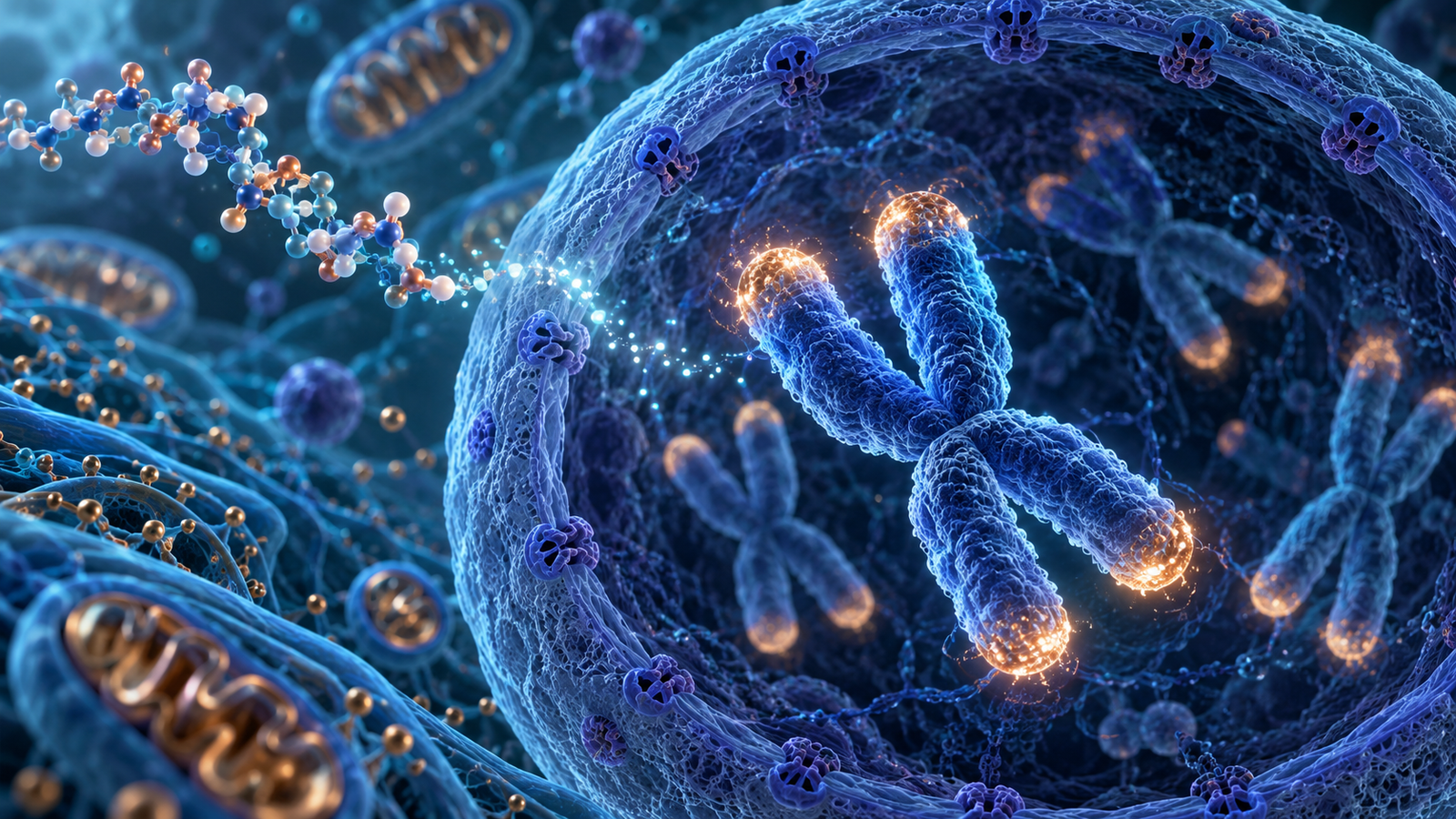
Research Area: Regeneration, Aging & Longevity Research
Epithalon—also written as Epitalon—is a short synthetic peptide made from four amino acids: alanine, glutamic acid, aspartic acid, and glycine. It appears in aging research because studies have connected it with telomeres and telomerase, two parts of the system that protects chromosome ends.
That connection is specific. Epithalon should not be treated as a general answer to aging, and a change in telomere length does not by itself show that an entire cell, tissue, or organism has become “younger.” The useful question is what telomere-related measurements can reveal—and what they cannot.
What telomeres actually do
Chromosomes are long packages of DNA. Their ends create a problem because the cell must distinguish a natural chromosome end from a broken piece of DNA. Telomeres solve much of that problem. They are repeating DNA sequences combined with protective proteins that form a specialized cap.
Each time many types of cells copy their DNA and divide, a small part of the telomere may be lost. Telomeres can also be affected by DNA damage and problems during replication. When a telomere becomes critically short or loses its protective structure, the cell can activate a damage response and stop dividing.
Telomerase rebuilds chromosome-end repeats
Telomerase is an enzyme that adds new repeated DNA to telomeres. One of its important components is hTERT, the protein that performs the copying reaction. Another component supplies the RNA template—the short pattern telomerase follows while adding DNA.
Telomerase activity is tightly controlled. It is active in certain renewing cell populations, but it remains low in many mature body cells. This matters because chromosome protection and growth control must stay balanced. Telomerase can help preserve telomeres, but telomerase activity alone does not prove that a cell is healthy or behaving normally.
Why Epithalon is studied
Epithalon research has reported changes in hTERT gene activity, telomerase activity, and telomere length. Those findings make the peptide useful for examining whether a short amino-acid signal can influence the cell’s chromosome-end maintenance system.
The mechanism is not fully mapped. Researchers still need to separate direct effects on telomerase regulation from broader changes in gene activity, stress responses, or cell state. Repeating a result across different cell types and measurement methods is important because telomere biology differs among tissues.
Telomere length is more complicated than “longer is better”
An average telomere measurement combines many chromosome ends. A cell can have a reasonable average while containing one or more critically short telomeres that trigger a damage response. Two cells with the same average length may also have different telomere-protecting proteins or different levels of chromosome instability.
Cell type matters too. Telomere length and telomerase activity naturally differ among renewing cells, mature cells, and cells that divide very little. A useful experiment therefore identifies the cell type and measures more than a single average value.
How telomeres connect with cellular senescence
Critically short or unprotected telomeres can help push a cell into senescence, a durable state in which the cell stops dividing. This can be protective because it prevents a damaged cell from copying itself. A senescent cell may remain active, however, and release signals that affect nearby tissue.
Telomere shortening is only one route into senescence. DNA damage, oxidative stress, disrupted growth signals, and mitochondrial problems can produce similar outcomes. Measuring senescence therefore requires several indicators rather than assuming every non-dividing cell reached that state because of its telomeres.
Key findings to understand
- Epithalon has been linked with telomerase-related activity. Published work has reported hTERT expression, telomerase activation, and telomere extension after exposure to the peptide.
- Telomere length is one measurement, not a complete aging score. Distribution, chromosome stability, cell type, and normal growth controls provide essential context.
- Telomerase is regulated for a reason. Researchers must examine whether telomere maintenance occurs alongside normal control of division and DNA-damage responses.
- The proposed pathway is still being refined. Reported telomere changes identify a research direction but do not settle every step between peptide exposure and the final measurement.
What a well-designed comparison measures
| Measurement | What it helps answer |
|---|---|
| Average telomere length | Whether the overall amount of repeated chromosome-end DNA changed |
| Shortest telomeres | Whether critically short chromosome ends remain hidden by an average |
| hTERT gene activity | Whether instructions for the telomerase catalytic protein changed |
| Telomerase activity | Whether the enzyme’s repeat-adding function changed |
| Chromosome stability | Whether chromosome ends remain protected and correctly separated |
| Cell growth and senescence markers | Whether telomere changes occur with normal or altered cell behavior |
How Epithalon differs from NAD+ and MOTS-C
Epithalon is used to ask a chromosome-end regulation question. NAD+ supports energy transfer and enzymes involved in repair and gene control. MOTS-C is studied as a mitochondrial stress signal that can influence nuclear gene activity. These systems can affect one another, but the starting mechanism and best measurements are different.
For a direct side-by-side explanation, see Epithalon vs. NAD+ vs. MOTS-C: Aging Research Compared. The broader Regeneration, Aging & Longevity Research page explains how these mechanisms fit into the wider biology of aging and repair.
Common questions
Is Epithalon the same as telomerase?
No. Epithalon is a short peptide. Telomerase is a large enzyme system that adds repeated DNA to chromosome ends. Epithalon is studied for whether it changes the regulation or activity of that system.
Does a telomere measurement show biological age?
It shows one part of chromosome-end biology. Aging also involves DNA repair, metabolism, mitochondria, inflammation, cell communication, protein maintenance, and tissue renewal. Telomere data should be interpreted with those other systems in mind.
Why measure the shortest telomeres?
A few critically short telomeres can activate a damage response even when the average appears acceptable. Looking at the distribution can reveal information hidden by one summary number.
Research product
View the CellTek Labs Epithalon research product.
References
- Epithalon, telomerase activity, and telomere elongation
- Epithalon and the division limit of human somatic cells
- Epitalon, hTERT activity, and telomere length
- Overview of Epitalon research
- Hallmarks of aging: an expanding universe
Research and educational content only. CellTek products are not for human or veterinary use.
