
Kisspeptin-10: The Signal Upstream of GnRH
Research Area: Reproductive & Neuroendocrine Research
Kisspeptin-10 is a short signaling peptide studied near the top of the reproductive hormone chain. Its main value as a research tool is not that it replaces a reproductive hormone. It helps researchers examine how the brain starts and times the sequence that later reaches the pituitary gland and reproductive tissues.
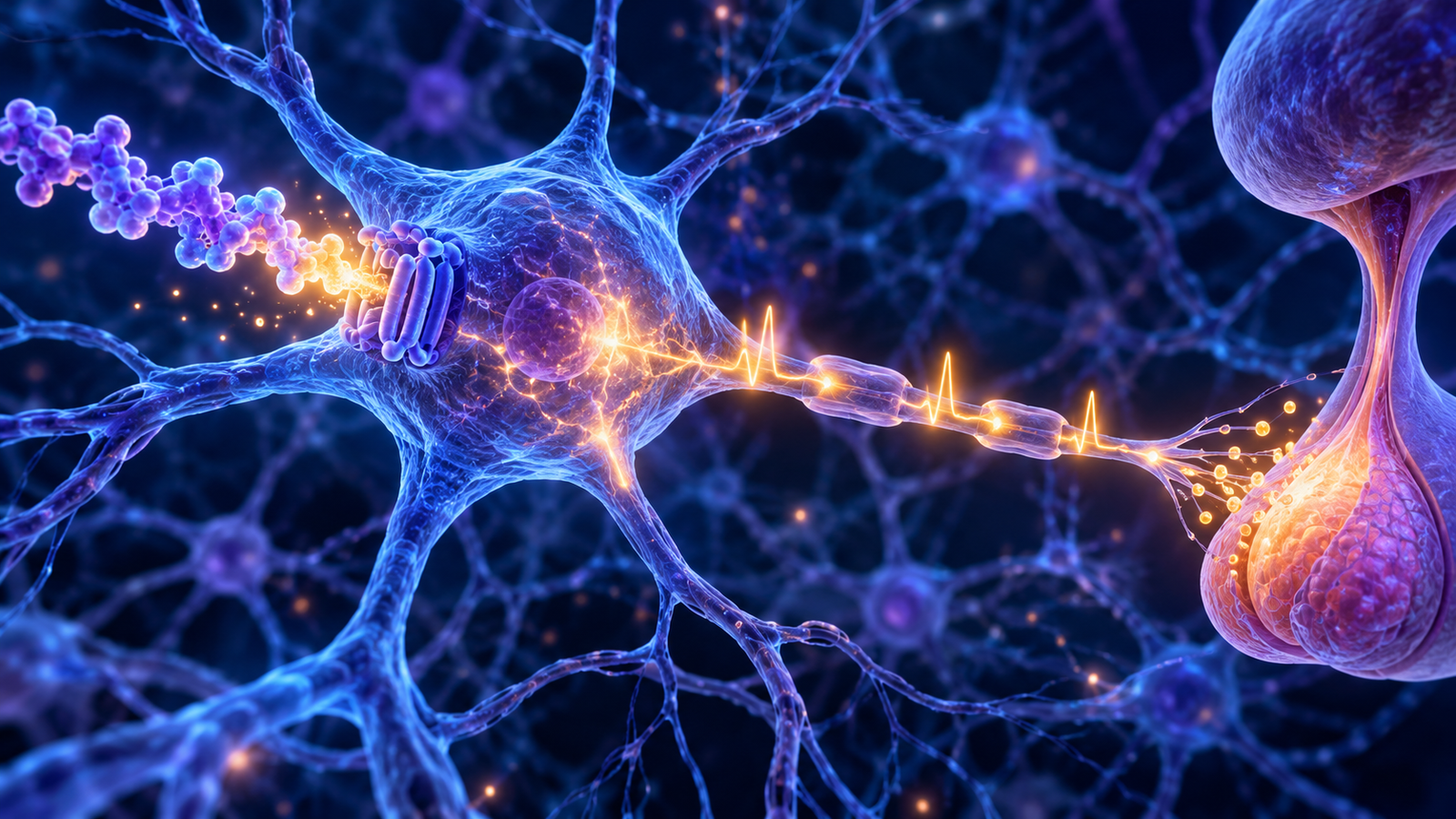
The Kisspeptin-10 research product connects most directly with KISS1R, GnRH-producing neurons, and the pulse patterns that organize luteinizing hormone release.
Where Kisspeptin-10 enters the pathway
The hypothalamus is a small brain region that connects the nervous system with hormone control. Within it, gonadotropin-releasing hormone neurons release GnRH. GnRH travels a short distance to the pituitary gland and tells it to release luteinizing hormone (LH) and follicle-stimulating hormone (FSH).
Kisspeptin acts one step earlier. It binds the kisspeptin receptor, usually called KISS1R, on many GnRH neurons. This is why Kisspeptin-10 is described as an upstream signal: it influences the cells that release GnRH rather than acting as GnRH itself.
Kisspeptin-10 is the shortest active fragment
The full kisspeptin protein can be cut into several shorter forms. These forms share a ten-amino-acid section at one end that is needed to activate KISS1R. Kisspeptin-10 is that active sequence. Researchers use it to examine receptor signaling without treating every form of kisspeptin as structurally identical.
KISS1R is a G-protein-coupled receptor, meaning it carries an outside message into the cell through an internal signaling partner. Activation can increase phospholipase C activity and raise calcium inside the neuron. Calcium is one of the signals that changes electrical activity and peptide release.
Why pulses matter
GnRH is released in bursts. The frequency and size of those bursts affect how the pituitary responds. Because direct GnRH measurement is difficult, researchers often use frequently sampled LH as a practical signal of GnRH pulse activity.
Studies have used Kisspeptin-10 to examine whether a pulse can be started, shifted, or sustained. The important measurement is not simply whether LH rose. Timing, pulse frequency, the starting hormone state, and the response of other parts of the axis help explain what changed.
Feedback reaches Kisspeptin neurons
Reproductive hormone control is a loop. Signals produced by reproductive tissues travel back to the brain and pituitary. Kisspeptin neurons receive part of that feedback. Some work also examines how they integrate signals related to energy availability, development, and stress.
A group of kisspeptin neurons can also produce neurokinin B and dynorphin. These are sometimes called KNDy neurons, using the first letters of the three signals. They are studied as part of the network that coordinates GnRH pulses rather than as a single on-off switch.
Key findings
- KISS1R sits upstream of GnRH. Activation of this receptor can change the signal that reaches the pituitary.
- Kisspeptin-10 contains the active receptor-binding sequence. It is one member of a family of related kisspeptin forms.
- LH can serve as a downstream timing marker. Frequent sampling reveals pulse patterns that a single measurement can hide.
- Feedback is central to interpretation. The same upstream signal can meet a different starting state at different points in a reproductive cycle.
- Kisspeptin is part of a network. Neurokinin B, dynorphin, sex-hormone feedback, and metabolic signals help shape the final rhythm.
What to measure
A useful Kisspeptin-10 study can connect KISS1R activation with electrical activity or calcium signaling, then follow GnRH-linked LH pulses and FSH. Timing should be recorded clearly. Baseline hormone conditions and the duration of observation can change how the same measurement is understood.
A larger response is not always a better response
Endocrine systems depend on pattern and proportion. A strong rise at one time point may not reproduce a normal pulse sequence, and a weak response may reflect feedback or receptor state rather than a failed interaction. Researchers compare the size of the response with its timing, duration, and relationship to the next pulse.
Repeated exposure adds another question: does the pathway remain responsive? Receptors and neurons can adjust after a signal. A study that compares the first and later responses can separate immediate activation from adaptation. This is especially useful when the goal is to understand pulse generation rather than a single peak.
To compare another level of the pathway, see HCG and LH/CG receptor signaling. For the broader map, read the Reproductive & Neuroendocrine Research area or the four-compound comparison.
Common questions
Is Kisspeptin-10 the same as GnRH?
No. Kisspeptin-10 activates KISS1R on GnRH-related neurons. GnRH is the later signal that travels from the hypothalamus to the pituitary.
Why measure LH instead of GnRH?
GnRH is released into a small circulation between the brain and pituitary and is difficult to sample directly. LH is released into the general bloodstream, so its pulses can provide a downstream view of GnRH activity.
Does one rise in LH describe the whole pathway?
No. It confirms a downstream response at that time. Pulse pattern, FSH, feedback hormones, receptor activity, and the starting state provide the larger picture.
Why can starting conditions change the result?
Kisspeptin neurons and the rest of the HPG axis receive ongoing feedback. Receptor availability and hormone conditions at the start of an experiment influence how much room the system has to respond.
References
- Kisspeptins and neuroendocrine control of reproduction
- The Kisspeptin-GnRH pathway
- Kisspeptin, neurokinin B, and GnRH pulse generation
- Kisspeptin and the GnRH pulse clock
- The GnRH pulse generator
Research and educational content only. CellTek products are not for human or veterinary use.
