
Kisspeptin-10 vs. Oxytocin vs. PT-141 vs. HCG: Neuroendocrine Research Compared
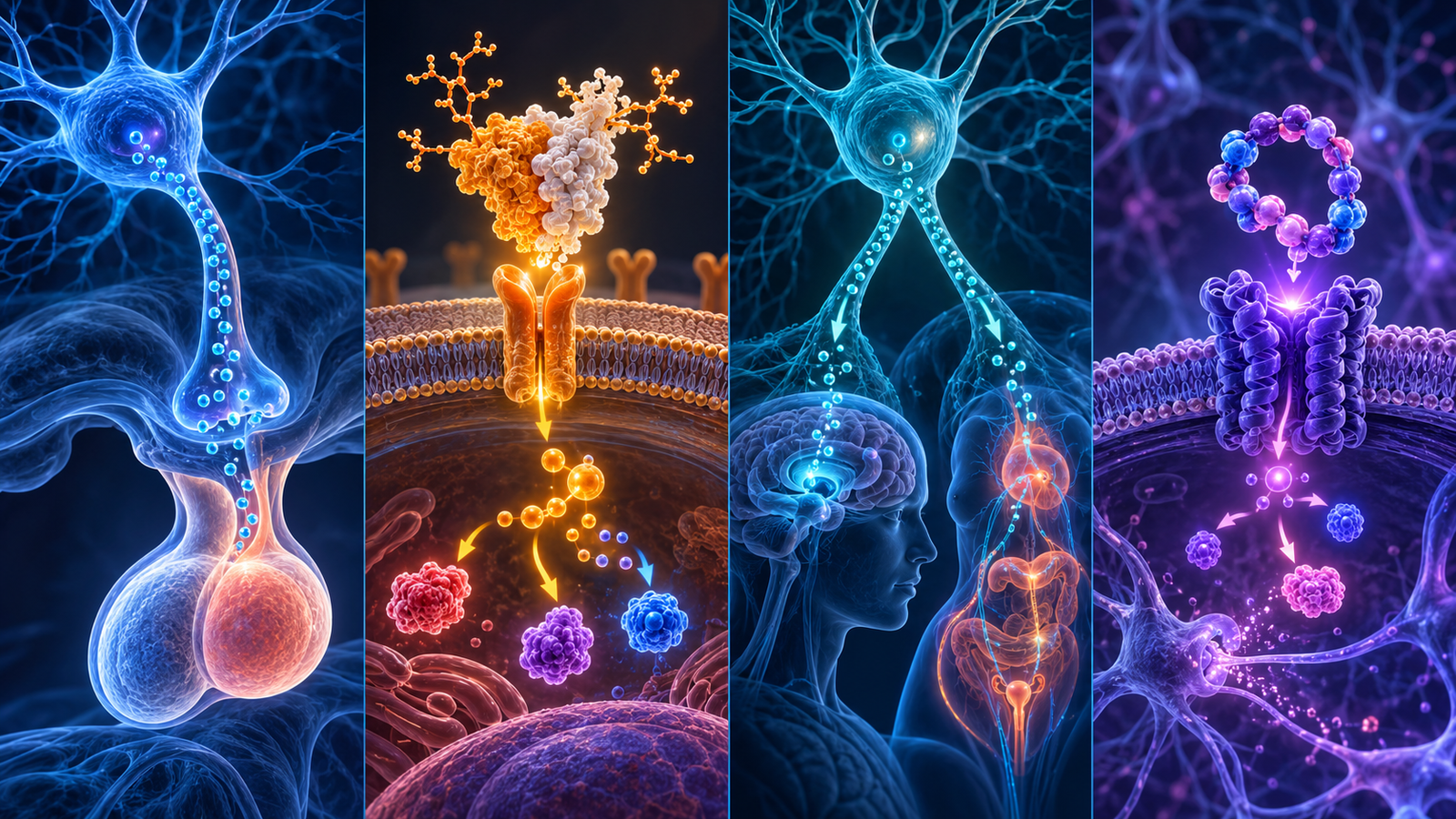
Research Area: Reproductive & Neuroendocrine Research
Kisspeptin-10, HCG, Oxytocin, and PT-141 all appear in reproductive or neuroendocrine research, but they do not answer the same question. They enter the brain-to-body signaling network at different points, activate different receptors, and require different measurements.
This comparison starts with mechanism: where the signal enters, which receptor receives it, what happens inside the cell, and which larger response researchers follow.
The four pathways at a glance
| Compound | Receptor or target | Position in the system | Central research question |
|---|---|---|---|
| Kisspeptin-10 | KISS1R | Upstream of GnRH | How an upstream brain signal changes reproductive hormone timing |
| HCG | LH/CG receptor | Downstream reproductive tissues | How receptor activation becomes cAMP signaling and hormone output |
| Oxytocin | OXTR | Brain and peripheral tissues | How receptor location and context change a shared signal |
| PT-141 | Melanocortin receptors, especially MC4R | Central neural circuits | How melanocortin activity is integrated into coordinated responses |
Kisspeptin-10 begins upstream
Kisspeptin-10 activates KISS1R on many GnRH-producing neurons. GnRH then tells the pituitary to release LH and FSH. Its research value centers on initiation, pulse timing, and feedback at the brain end of the HPG axis.
Choose this pathway when the question concerns GnRH-linked timing or how upstream signals are integrated before the pituitary responds. Frequent LH sampling can reveal pulse changes that a single measurement misses.
HCG begins downstream
HCG binds LHCGR in target tissues. It does not need to begin with the hypothalamus or pituitary to activate that receptor. Its main research questions involve cAMP, PKA, steroid-hormone production, receptor regulation, and the duration of the signal.
Choose this pathway when the receptor and downstream tissue response are the focus. Include LH as a useful comparator because the two hormones share LHCGR but can favor different signaling patterns.
Oxytocin crosses several systems
Oxytocin is released within the brain and into the bloodstream. OXTR can raise calcium inside a cell and appears in several tissues. Its broad distribution makes location the first design decision.
Choose this pathway when the question concerns brain-to-body communication, reproductive tissue activity, stress regulation, or a defined neural circuit. Avoid treating a blood measurement as a direct substitute for local brain release.
PT-141 centers on melanocortin circuits
PT-141 activates melanocortin receptors in the central nervous system. MC4R is especially important to its research profile. The signal is integrated across neural circuits and can affect autonomic and behavioral responses.
Choose this pathway when the question concerns central melanocortin signaling. Do not use HPG-axis measurements alone to describe it, because PT-141 does not begin as a Kisspeptin-GnRH-LH signal.
The most useful head-to-head distinctions
- Kisspeptin-10 vs. HCG: upstream control of the hormone chain versus direct activation of a downstream receptor.
- Oxytocin vs. PT-141: a natural signal released centrally and peripherally versus a synthetic melanocortin agonist studied primarily through central receptors.
- Kisspeptin-10 vs. PT-141: GnRH-linked reproductive timing versus melanocortin circuit integration.
- HCG vs. Oxytocin: LHCGR-linked endocrine output versus OXTR signaling whose meaning depends strongly on tissue location.
Matching measurements to the mechanism
For Kisspeptin-10, connect KISS1R activity with GnRH-linked LH pulses and feedback. For HCG, connect LHCGR activation with cAMP, PKA, receptor internalization, and hormone output. For Oxytocin, define OXTR location and pair calcium signaling with a specific tissue or circuit response. For PT-141, measure melanocortin receptor activity, neural integration, autonomic output, and a clearly defined response.
The common rule is to avoid jumping directly from receptor binding to a broad conclusion. A complete chain includes the receptor, the internal message, and the larger response.
Why category labels can mislead
Grouping all four compounds under reproductive research is useful for navigation, but it can hide their biological distance. Kisspeptin-10 and HCG occupy different levels of one endocrine chain. Oxytocin belongs to a distributed signaling system. PT-141 begins with central melanocortin receptors. A product category should organize discovery, not replace a mechanism comparison.
The clearest study title names both the compound and the level being measured—for example, KISS1R-to-LH timing, LHCGR-to-cAMP signaling, OXTR activity in a defined tissue, or MC4R-linked circuit output. That wording makes the scope visible before results are interpreted.
Common questions
Which compounds directly belong to the HPG axis?
Kisspeptin-10 acts upstream of GnRH, and HCG activates a downstream receptor shared with LH. Oxytocin and PT-141 intersect with reproductive research through different neuroendocrine pathways.
Which comparison most clearly shows upstream versus downstream signaling?
Kisspeptin-10 versus HCG. One begins near the brain-level start of the reproductive chain; the other activates a receptor in downstream target tissues.
Can the same measurements be used for all four?
No. Some general measurements overlap, but each pathway requires markers tied to its receptor, internal signals, timing, and location.
Return to the Reproductive & Neuroendocrine Research area for the full system map.
References
- Kisspeptin and reproductive neuroendocrine control
- LH and HCG signaling through a shared receptor
- Oxytocin receptor signaling
- Bremelanotide neurobiology
- The GnRH pulse generator
Research and educational content only. CellTek products are not for human or veterinary use.
