
Oxytocin: Receptor Signaling from Brain to Body
Research Area: Reproductive & Neuroendocrine Research
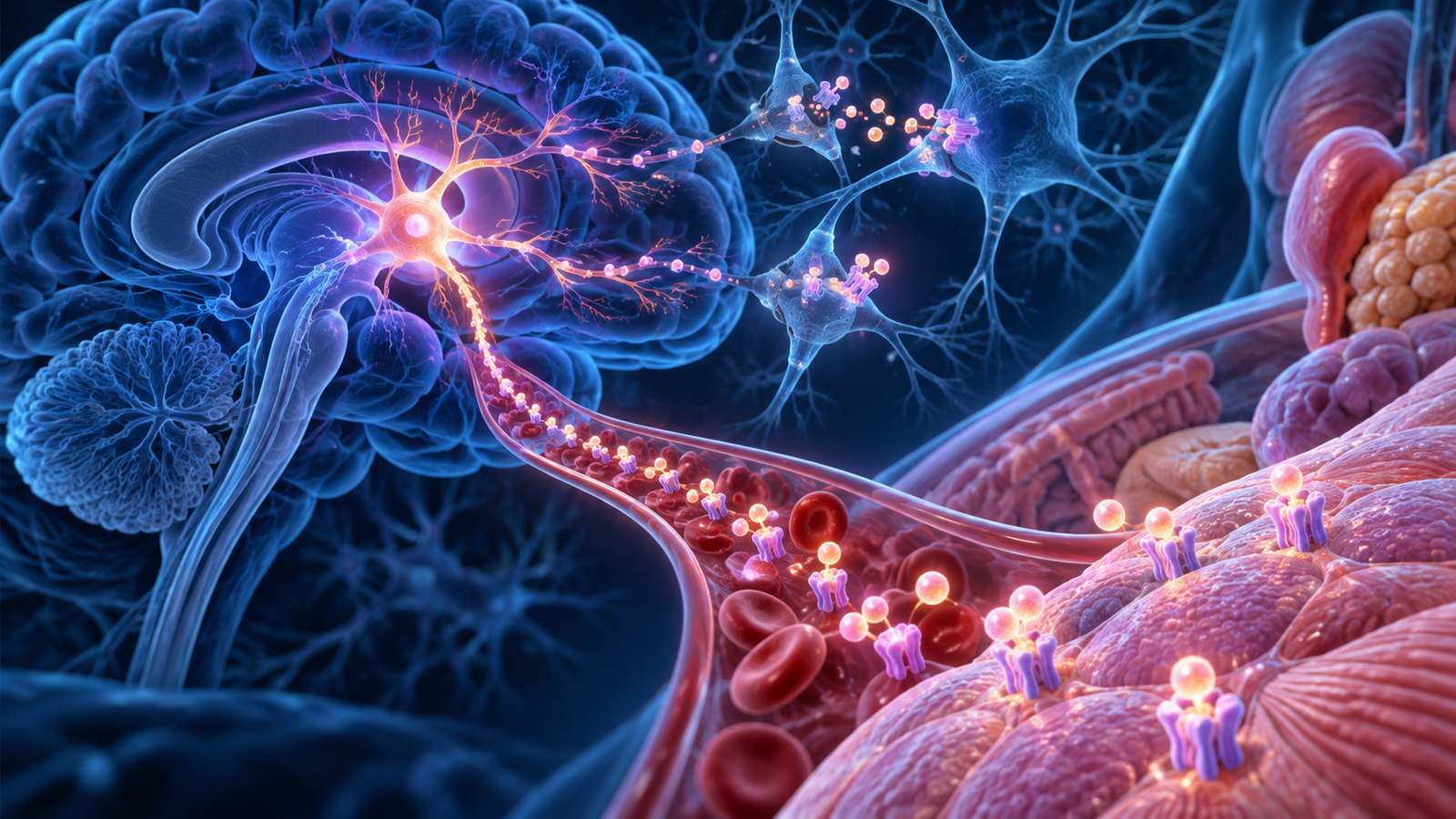
Oxytocin is a nine-amino-acid hormone and signaling peptide. It is often reduced to a single nickname or behavior, but its biology is broader. Oxytocin is released in the brain and into the bloodstream, and its receptor appears in several tissues. The same molecule can therefore participate in different research questions depending on where, when, and how the signal is measured.
The Oxytocin research product is most useful when a study defines the location of the receptor, the route of the signal, and the response being observed.
Where oxytocin is made and released
Oxytocin is produced mainly by specialized neurons in the hypothalamus. Some of those neurons send long projections to the posterior pituitary, where oxytocin is released into the bloodstream. Others release it within the brain, where it can change the activity of local circuits.
Central release means release within the brain. Peripheral release means release into the bloodstream or activity in tissues outside the brain. These routes are connected, but they are not interchangeable. A blood measurement does not automatically reveal how much signaling occurred at a specific brain connection.
The oxytocin receptor converts the message
The oxytocin receptor, shortened to OXTR, is a G-protein-coupled receptor. In a commonly studied pathway, OXTR activates phospholipase C, which produces internal messengers and raises calcium inside the cell. Calcium then changes processes such as contraction, secretion, electrical activity, and gene regulation.
OXTR can connect with more than one internal pathway. The responding cell, receptor density, signal duration, and nearby receptors can all affect the outcome. This is why “oxytocin receptor activation” is a starting point, not a complete explanation.
Reproductive and neuroendocrine roles use the same signal differently
In reproductive tissues, oxytocin signaling is studied for smooth-muscle contraction and local communication. In the brain, researchers examine networks related to stress, attention to social information, learning, and coordinated behavior. These are different levels of analysis even when OXTR is involved in both.
Oxytocin neurons also communicate with stress-regulating systems. Allostasis means the body changes its activity to maintain stability during a challenge. Oxytocin research asks how the signal participates in that adjustment, not whether it always raises or lowers a single stress marker.
Context changes the response
A brain circuit interprets oxytocin alongside sensory information, prior learning, other hormones, and current conditions. The same receptor signal can have different meaning in different circuits. Sex, timing, receptor distribution, and the surrounding situation are therefore study variables rather than side notes.
Release can also be pulsatile. A short burst may carry a different message from continuous exposure. Receptors can become less responsive or move inside the cell after activation, changing the response to later signals.
Key findings
- Oxytocin has central and peripheral routes. Brain release and bloodstream release answer different research questions.
- OXTR often signals through calcium. That internal messenger can change contraction, secretion, electrical activity, and gene expression.
- Receptor location shapes meaning. An OXTR response in one tissue should not be generalized to every other tissue.
- Context is part of the mechanism. Other signals and current conditions change how a neural circuit processes oxytocin.
- Timing changes receptor behavior. Pulses, continuous exposure, desensitization, and receptor recycling can produce different patterns.
What to measure
A strong design identifies where OXTR is expressed, measures receptor-linked calcium or other internal signals, and pairs those data with a defined tissue or circuit response. Release timing and receptor responsiveness can explain why the same concentration does not always produce the same result.
Measurement location sets the boundary of the conclusion
Oxytocin is released locally and can be broken down quickly. A measurement from blood, tissue fluid, or a defined brain region describes that location; it does not automatically represent every compartment. Researchers strengthen interpretation by pairing concentration data with OXTR activity in the same system.
Receptor density matters too. A tissue with more available OXTR may respond differently from one with fewer receptors even when both encounter the same concentration. Measuring receptor expression, internal signaling, and the final response helps separate signal availability from tissue sensitivity.
Compare this distributed brain-to-body system with PT-141’s central melanocortin pathway. The four-compound comparison and research-area guide show where Oxytocin fits beside Kisspeptin-10 and HCG.
Common questions
Is blood oxytocin the same as oxytocin signaling in the brain?
No. The two systems can be coordinated, but a blood concentration does not directly measure release at a particular brain circuit.
Does Oxytocin have only one effect?
No. OXTR is found in different tissues and circuits. The responding cells and surrounding signals help determine what happens next.
Why measure receptor location?
Because the same receptor can control different cell behaviors. Location links molecular signaling to a specific biological question.
Can a single oxytocin concentration predict a behavioral response?
No. Neural circuits also process sensory input, learning, other hormones, and the surrounding context. Concentration is one part of a larger signaling system.
References
- The oxytocin receptor: from intracellular signaling to behavior
- Oxytocin receptor structure, function, and regulation
- The oxytocin receptor signaling network
- Oxytocin in stress responses and adaptation
- Oxytocin receptor signaling and calcium
Research and educational content only. CellTek products are not for human or veterinary use.
