
HCG: LH/CG Receptor Signaling and Endocrine Feedback
Research Area: Reproductive & Neuroendocrine Research
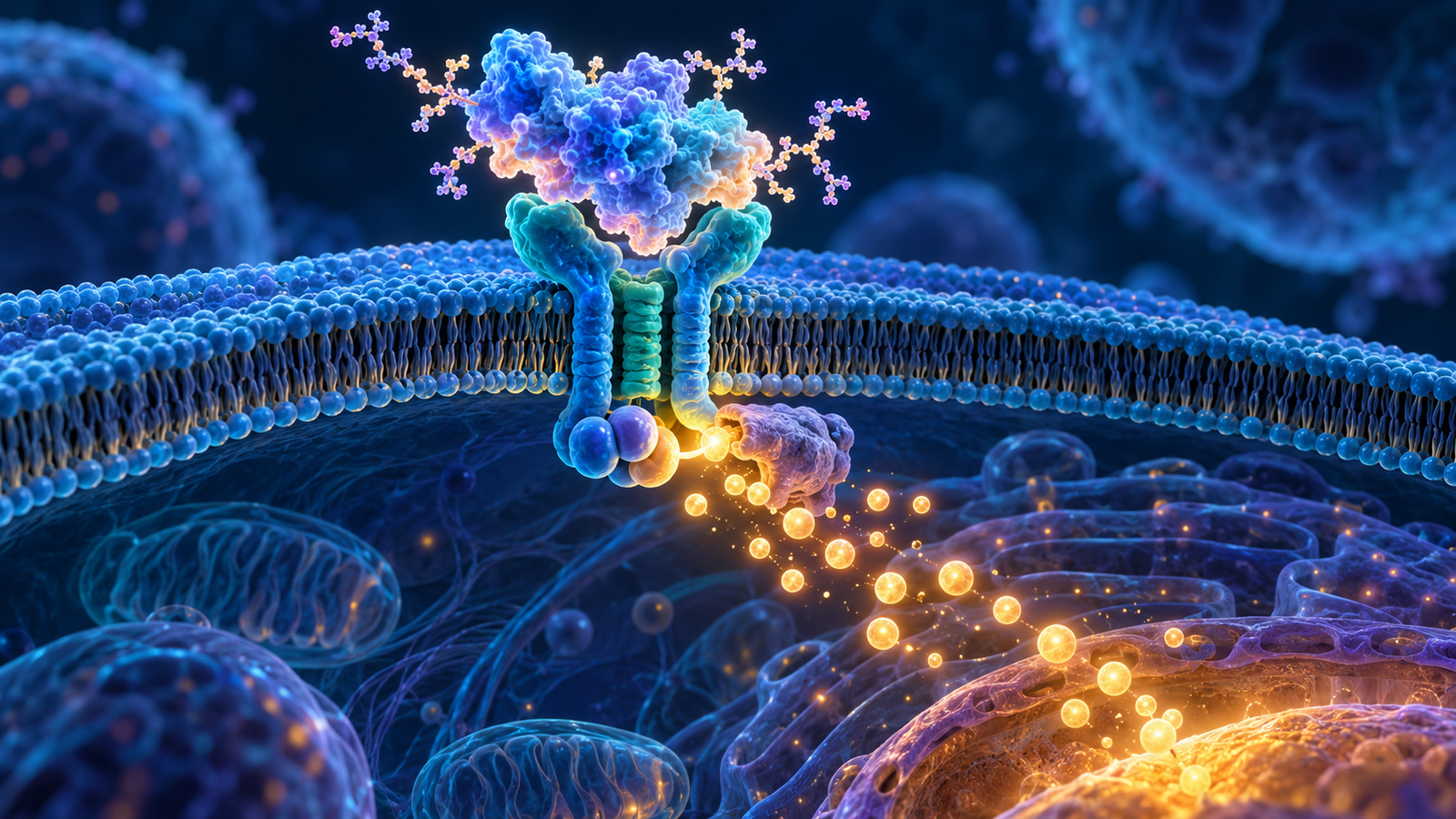
Human chorionic gonadotropin, usually shortened to HCG or hCG, is a large protein hormone studied for the way it activates the luteinizing hormone/chorionic gonadotropin receptor. That receptor name is long, but its central idea is simple: luteinizing hormone and HCG can deliver messages through the same receptor.
The HCG research product is therefore useful for questions about downstream reproductive signaling. It acts closer to reproductive tissues than Kisspeptin-10 or GnRH, which begin their work farther upstream in the brain and pituitary.
Where HCG enters the hormone chain
In the HPG axis, the hypothalamus releases GnRH, the pituitary releases LH and FSH, and reproductive tissues receive those pituitary signals. HCG does not replace the entire chain. It binds the receptor normally activated by LH at the downstream end of it.
The receptor is called LHCGR. It belongs to the G-protein-coupled receptor family, meaning it transfers an outside message into the cell. LHCGR is best known in cells that produce steroid hormones, although research has also examined its presence in other reproductive tissues.
The cAMP message inside the cell
When HCG binds LHCGR, one major pathway activates adenylyl cyclase, an enzyme that produces cyclic AMP. Cyclic AMP, or cAMP, is a small messenger that carries the receptor’s instruction through the cell. It can activate protein kinase A, usually shortened to PKA, which changes the activity of other proteins.
Researchers may follow cAMP, PKA targets, gene activity, and steroid-hormone output. Measuring only the final hormone can miss how quickly the receptor responded, how long the internal signal lasted, or whether another pathway contributed.
LH and HCG share a receptor but are not identical
LH and HCG are related glycoprotein hormones. A glycoprotein is a protein with attached sugar groups. Those structural differences affect how long each hormone remains available and how it interacts with the receptor.
Research has found that the two hormones can favor different internal signaling patterns even when both bind LHCGR. This idea is sometimes called biased signaling: one receptor can send more than one kind of internal message, and different ligands—the molecules that bind it—may favor different branches.
Receptor regulation changes the response
A receptor does not remain equally responsive forever. After activation, it may be modified, pulled inside the cell, recycled, or broken down. These processes help prevent a continuous outside signal from producing an unlimited response. Researchers call the loss of responsiveness desensitization and the movement of a receptor into the cell internalization.
This makes dose, exposure time, and the gap between signals important experimental variables. Two designs with the same final concentration can create different results if one uses a short pulse and the other maintains exposure.
Key findings
- HCG acts downstream in the reproductive axis. It activates LHCGR in target tissues rather than initiating the brain-to-pituitary sequence.
- cAMP is a central internal messenger. It connects receptor activation with protein activity and gene regulation.
- LH and HCG are related but not interchangeable. Structure, persistence, and favored signaling branches can differ.
- Receptor behavior changes over time. Desensitization and internalization can alter later responses.
- Timing belongs in the result. Signal strength, duration, and recovery can be as informative as the final hormone measurement.
What to measure
A useful HCG experiment can measure LHCGR binding or activation, cAMP production, PKA activity, downstream gene expression, and steroid-hormone output. Receptor internalization and recovery help show whether repeated signals are being processed differently.
Molecular structure affects signal duration
HCG contains two protein subunits and several attached sugar chains. Those sugar groups influence folding, receptor interaction, and how quickly the hormone is removed. LH has a related overall design, but its attached sugars and circulating lifetime differ. These structural details help explain why equal receptor binding does not guarantee an equal time course.
A time-course experiment can measure early cAMP, later protein activity, receptor internalization, and eventual hormone output. This reveals whether two signals reach a similar endpoint through different timing. It also prevents a long-lasting signal from being described only as a stronger version of a short one.
For the upstream side of the same hormone chain, read Kisspeptin-10: The Signal Upstream of GnRH. The neuroendocrine comparison separates HCG from Oxytocin and PT-141, while the research-area guide maps the full system.
Common questions
Is HCG a peptide?
It is a protein hormone made from amino acids, but it is much larger and more structurally complex than short peptides such as Kisspeptin-10 or PT-141. It also carries attached sugar groups.
Does HCG bind a separate HCG-only receptor?
No. HCG and LH bind the shared LH/CG receptor, LHCGR.
Does shared receptor binding mean identical signaling?
No. The same receptor can support several internal pathways. Hormone structure, exposure time, receptor regulation, and the responding tissue can change the pattern.
Why compare HCG with LH?
LH provides the closest natural receptor comparison. Measuring both shows whether a result belongs to shared LHCGR activation or to the distinct timing and signaling pattern of one ligand.
References
- LH and HCG: two hormones for one receptor
- Luteinizing hormone receptor structure and signaling
- The timing and location of HCG/cAMP signaling
- LH/CG receptor signal generation and divergence
- Molecular and functional differences between HCG and LH
Research and educational content only. CellTek products are not for human or veterinary use.
