
Cellular Growth & Tissue Repair Research
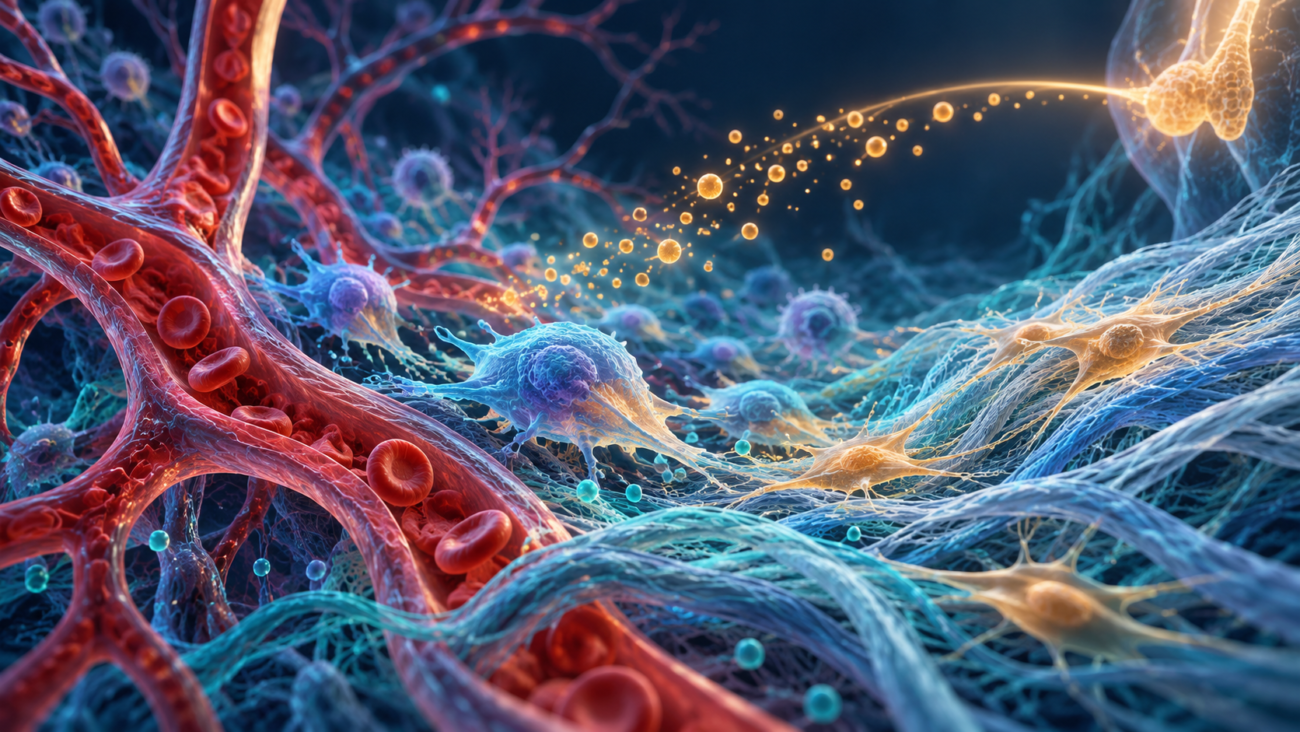
Cellular growth and tissue repair are connected processes, but they are not the same thing. Growth describes changes in cell size, number, or activity. Repair is a coordinated sequence that clears damaged material, moves new cells into position, rebuilds structural support, and restores blood supply. Peptide research in this area asks where a compound enters that sequence and which signals change afterward.
The major systems researchers follow
- Growth-hormone signaling: messages moving from GHRH to growth hormone and then to IGF-1 and other downstream pathways.
- Cell migration: the controlled movement of repair cells into an area where new structure is needed.
- Angiogenesis: the formation of new blood vessels that can deliver oxygen and nutrients to rebuilding tissue.
- Extracellular matrix remodeling: the breakdown and rebuilding of collagen and other material surrounding cells.
- Inflammatory resolution: the shift from an early alarm response toward rebuilding and restored tissue balance.
The growth-hormone signaling chain
GHRH, or growth-hormone-releasing hormone, is a message sent to the pituitary gland. The pituitary can respond by releasing growth hormone in pulses. Growth hormone then binds its own receptor and activates internal pathways, including JAK2 and STAT5. These are relay proteins that carry a message from the cell surface toward the genes that control a response. One important result is regulation of IGF-1, or insulin-like growth factor 1.
The chain is useful because products enter it at different points. HGH is growth hormone itself. Sermorelin, Tesamorelin, and CJC-1295 with DAC are related to the GHRH side of the pathway. Ipamorelin uses the growth-hormone secretagogue receptor, a different receiver that can also influence growth-hormone release. Read Growth Hormone Signaling: GHRH, GH, and IGF-1.
Compounds in this research area
CJC-1295 with and without DAC
CJC-1295 is a GHRH-related peptide. DAC means drug affinity complex, a structural feature designed to bind albumin, a common blood protein, and extend how long a compound remains available. The DAC product and No DAC product therefore should not be treated as interchangeable. The useful comparison is timing and exposure, not a simple stronger-versus-weaker ranking. See CJC-1295 DAC vs. No DAC: Structure, Duration, and Research Design.
Sermorelin, Tesamorelin, and Ipamorelin
Sermorelin and Tesamorelin act through the GHRH receptor, while Ipamorelin belongs to the growth-hormone secretagogue family and acts through a ghrelin-related receptor. The three compounds can be grouped by the research outcome—growth-hormone release—but the first signal and receptor are different. The article Sermorelin vs. Tesamorelin vs. Ipamorelin explains those distinctions.
AOD-9604
AOD-9604 is based on a short section near the end of growth hormone rather than the full hormone. Its literature focuses on lipid signaling and energy balance. Published work has reported that its actions do not simply reproduce full growth-hormone receptor signaling. Read AOD-9604: Growth-Hormone Fragment and Metabolic Signaling.
BPC-157 and TB-500
BPC-157 and TB-500 are discussed around repair rather than the GHRH-growth-hormone chain. BPC-157 research includes cell migration, blood-vessel signaling, and FAK-paxillin, a system that helps cells attach and move. TB-500 is associated with an actin-binding region of thymosin beta-4. Actin is a structural protein cells use to maintain shape and move. See BPC-157 vs. TB-500: Tissue-Repair Pathways Compared. A BPC-157 + TB-500 product is also available.
Connected products with existing coverage
HCG can influence endocrine signaling that intersects with growth and reproductive biology; its dedicated article is HCG: LH/CG Receptor Signaling and Endocrine Feedback. MOTS-C is tied more closely to mitochondrial and metabolic signaling than to growth-hormone release; see MOTS-C: Mitochondrial Signaling, Cellular Energy, and Key Findings.
How the pathways compare
| Research group | Entry point | Common measurements |
|---|---|---|
| Sermorelin, Tesamorelin, CJC-1295 with DAC, and CJC-1295 No DAC | GHRH receptor | Growth-hormone pulses, IGF-1, duration |
| Ipamorelin | Growth-hormone secretagogue receptor | Growth-hormone response and timing |
| HGH | Growth-hormone receptor | JAK-STAT signaling, IGF-1, metabolic markers |
| AOD-9604 | Growth-hormone fragment pathway | Lipid breakdown and energy-balance markers |
| BPC-157 | Repair-related signaling network | Migration, VEGF-related signaling, structural repair |
| TB-500 / thymosin beta-4 research | Actin and cell-movement systems | Migration, vessel formation, repair organization |
What a tissue-repair finding tells us
Repair is a sequence, so one marker represents one step. More cell migration shows that cells moved; it does not show that the final structure formed correctly. More blood-vessel signaling shows that a supply network may be developing; it does not show that collagen became properly aligned. Strong pathway research connects several measurements across time.
The same rule applies to hormone measurements. A rise in growth hormone or IGF-1 shows that the signaling chain responded. It does not make every possible growth-related outcome follow automatically. Timing, receptor activity, tissue type, and feedback signals all shape the next step.
Common questions
Is growth hormone the same as IGF-1?
No. Growth hormone is a messenger with its own receptor. One of its major downstream effects is regulation of IGF-1, another messenger with a different receptor. The two signals interact but are not interchangeable.
Does DAC change what CJC-1295 is designed to do?
DAC mainly changes duration by encouraging binding to albumin. That can change the timing and persistence of exposure, which affects how a study should be designed and interpreted.
Are TB-500 and thymosin beta-4 identical?
No. Thymosin beta-4 is a naturally occurring 43-amino-acid protein. TB-500 is associated with a shorter active region. Findings about the full protein help explain possible pathways, but they should not be presented as direct proof that every fragment behaves identically.
Learn More by Product
Choose a product to view its catalog page, then open the related article for a focused explanation of its pathway, key findings, and comparisons.
References
- The growth hormone–STAT5–IGF-1 signaling circuit (PubMed)
- CJC-1295 and GH/IGF-1 signaling duration (PubMed)
- Ipamorelin and selective growth-hormone release (PubMed)
- BPC-157, cell migration, and FAK-paxillin signaling (PubMed)
- Thymosin beta-4 active regions and repair signaling (PubMed)
For research and educational purposes only. Not for human or animal consumption.
