
Thymosin Alpha-1: Immune Coordination and Key Findings
Research Area: Immune & Inflammatory Signaling Research
Thymosin Alpha-1 is a naturally occurring 28-amino-acid peptide associated with the thymus, an organ involved in the development and selection of T cells. Research on the peptide focuses less on “boosting” immunity and more on coordination: how early recognition signals shape dendritic cells, T cells, cytokines, and immune tolerance.
That distinction matters because a useful immune response needs both activation and restraint. More activity is not automatically better. Researchers examine whether the right cells receive the right instructions at the right time.
Dendritic cells connect innate and adaptive immunity
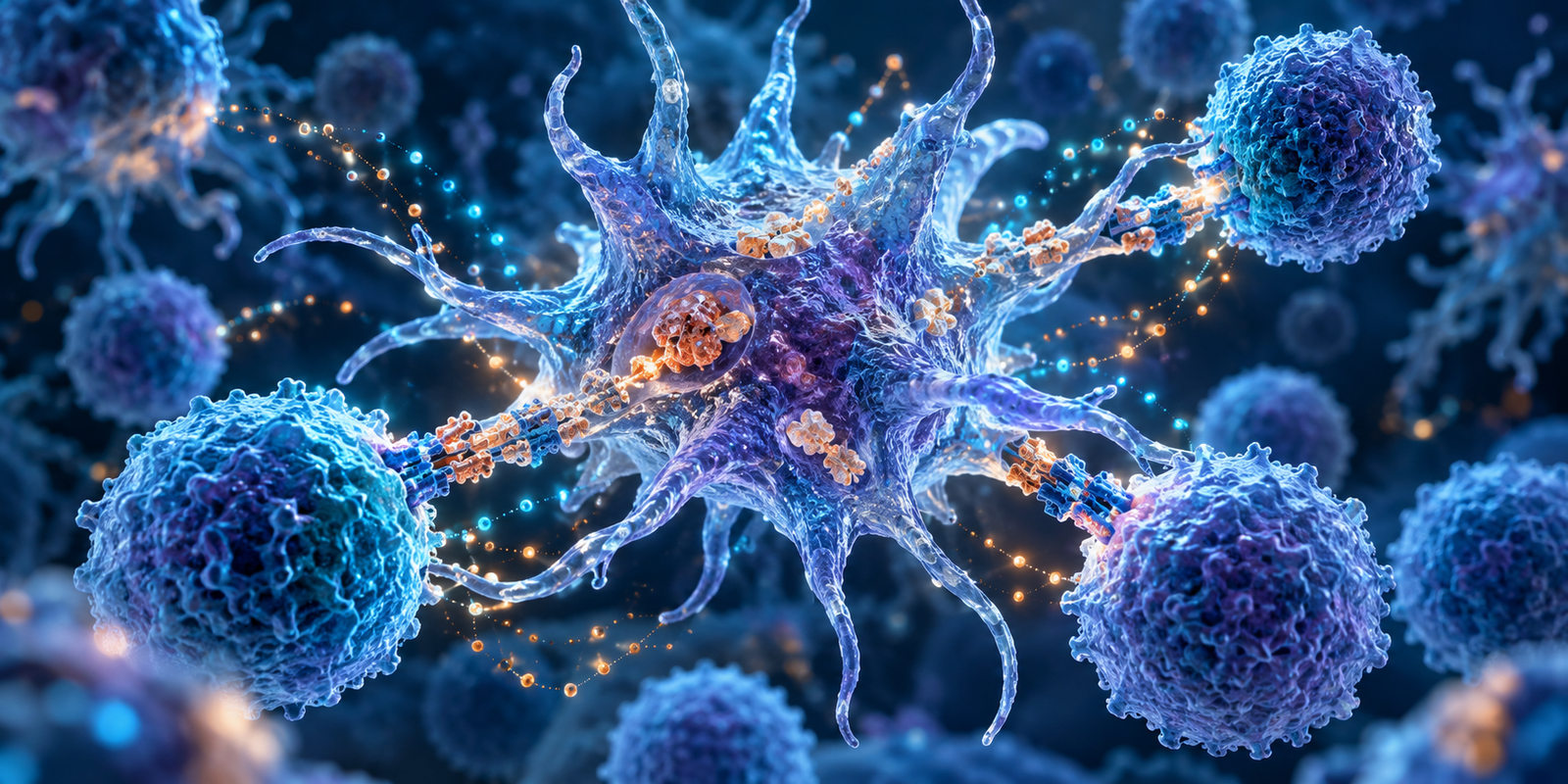
Dendritic cells act as information processors. They sample material in tissues, respond to surrounding signals, and display selected molecular fragments to T cells. This display is called antigen presentation. Antigen means a molecular feature that an immune receptor can recognize.
Presentation alone does not determine the result. Dendritic cells also provide supporting signals that help T cells decide whether to activate, what type of response to develop, or whether restraint is more appropriate. Their condition therefore influences the direction of the adaptive response.
Toll-like receptors provide early recognition signals
Toll-like receptors, or TLRs, are pattern-recognition receptors used by innate immune cells. They detect broad molecular patterns associated with microbes or cellular stress. Different TLRs recognize different patterns and activate different combinations of signaling proteins.
Thymosin Alpha-1 research has connected the peptide with TLR pathways in dendritic cells. Downstream signals can involve MyD88, NF-κB, and interferon-regulatory proteins. These molecules help change gene activity and cytokine production, but the result depends on the receptor, cell type, and surrounding environment.
Interferons and cytokines carry the message forward
Interferons are cytokines that help cells coordinate responses to certain threats. Other cytokines influence T-cell development, natural killer cell activity, inflammation, or restraint. Measuring one cytokine does not describe the complete response because immune cells read combinations of signals.
A strong study may therefore measure several layers: receptor activation, dendritic-cell maturation, cytokine patterns, T-cell subsets, and the function those cells perform. This helps distinguish a molecular signal from a coordinated immune outcome.
T-cell responses are not all the same
T cells include multiple groups with different jobs. Helper T cells organize responses through cytokines. Cytotoxic T cells can remove selected cells. Regulatory T cells help limit unnecessary or damaging activity. The balance among these groups is more informative than a total T-cell count alone.
Thymosin Alpha-1 research examines how immune coordination may affect these functional patterns. Depending on the question, researchers may measure cell-surface markers, cytokines, proliferation, killing activity, or regulatory signals.
Immune tolerance is active control
Immune tolerance is the controlled decision not to attack the body’s own material or other harmless signals. It is not simply weakness. Dendritic cells can support tolerance by influencing regulatory T cells and enzymes that change the local signaling environment.
This gives Thymosin Alpha-1 research two connected branches: supporting effective recognition when a response is appropriate and supporting regulation when uncontrolled activation would be disruptive. The surrounding immune context determines which branch is relevant.
Key findings to understand
- Thymosin Alpha-1 is an immune-modulating peptide. Its research spans innate recognition, dendritic-cell function, and adaptive immune coordination.
- Dendritic cells are a central research target. They translate early pattern-recognition signals into instructions that shape T-cell responses.
- Toll-like receptor pathways provide mechanism-specific measurements. TLR activity, MyD88, NF-κB, interferon-regulatory proteins, and cytokines can show how a signal moves through the cell.
- Activation and tolerance are both organized outcomes. The same immune network must recognize meaningful signals while limiting inappropriate responses.
- No single immune marker proves coordination. Receptor activity, cell identity, cytokines, and function should be interpreted together.
Measurements that answer different questions
| Measurement | What it helps answer |
|---|---|
| TLR pathway activity | Whether early pattern-recognition signaling changed |
| Dendritic-cell maturation markers | Whether antigen-presenting cells changed their functional state |
| Cytokine pattern | Which types of instructions immune cells released |
| T-cell subsets | Whether helper, cytotoxic, or regulatory populations changed |
| Cell function | Whether signaling produced a measurable immune-cell action |
| Tolerance-related markers | Whether regulatory pathways changed alongside activation |
How Thymosin Alpha-1 differs from KPV and ARA-290
Thymosin Alpha-1 centers on immune-cell coordination. KPV centers on inflammatory signaling and barrier tissues. ARA-290 centers on a paired receptor that carries tissue-protective signals after stress.
See Thymosin Alpha-1 vs. KPV vs. ARA-290: Immune Research Compared, or return to Immune & Inflammatory Signaling Research for the broader framework.
Common questions
Does immune modulation mean immune stimulation?
No. Modulation means changing how the system is organized or regulated. The result may involve activation, restraint, tolerance, or a shift in which cells participate.
Why are dendritic cells important?
They link early innate recognition with later adaptive decisions. They present antigens and provide supporting signals that shape T-cell behavior.
Can cytokine levels alone show immune function?
No. Cytokines describe communication. Cell identity, receptor activity, timing, and measurable cell behavior provide the context needed to interpret them.
Research product
View the CellTek Labs Thymosin Alpha-1 research product.
References
- Immune modulation with Thymosin Alpha-1
- Thymosin Alpha-1, inflammation, immunity, and tolerance
- Thymosin Alpha-1 and immune regulation
- Thymosin Alpha-1 and innate cell-mediated responses
- Comprehensive review of Thymosin Alpha-1 research
Research and educational content only. CellTek products are not for human or veterinary use.
