
Reproductive & Neuroendocrine Research
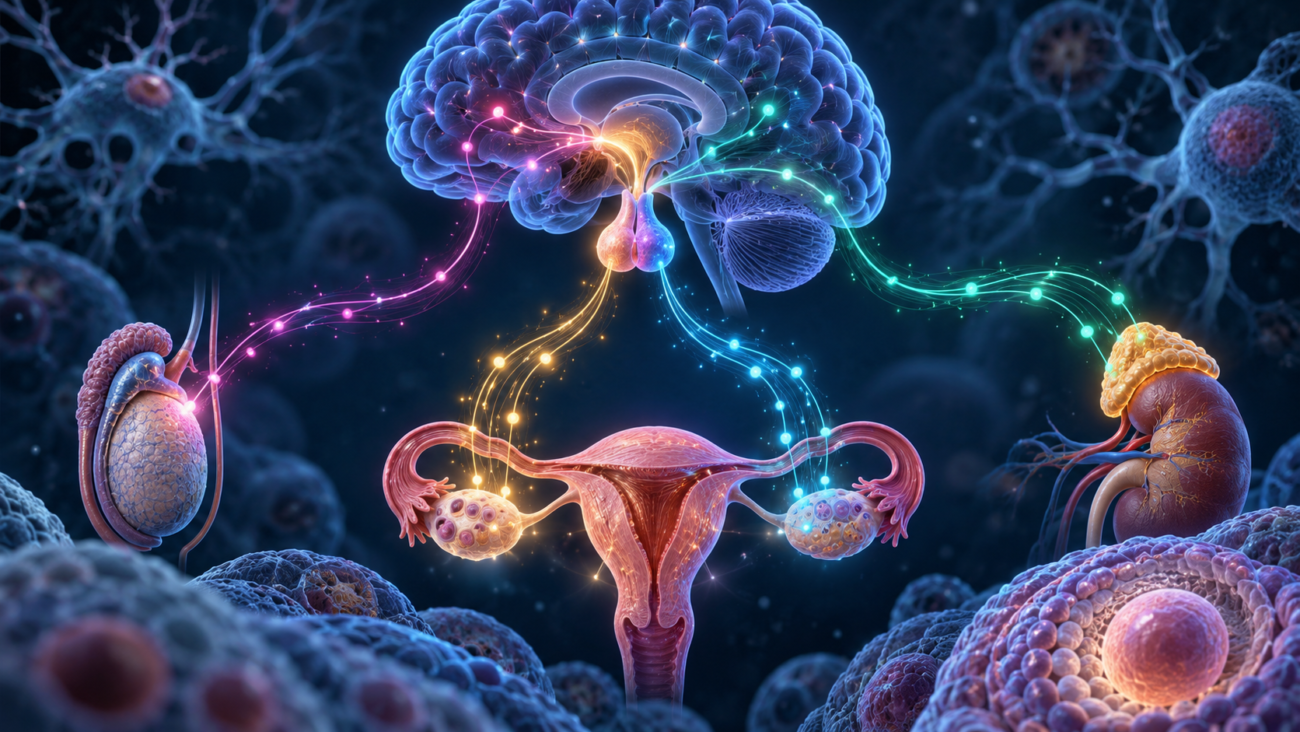
The reproductive system does not operate from a single hormone or a single organ. It works through a timed conversation between the brain, the pituitary gland, reproductive tissues, and signals returning from the body. Neuroendocrine research studies that conversation: how nerve cells release hormone instructions, how glands relay them, and how feedback changes the next message.
Four CellTek compounds enter this system at very different points. Kisspeptin-10 is studied near the start of the reproductive hormone chain. HCG acts farther downstream at the receptor shared with luteinizing hormone. Oxytocin carries signals between the brain and several body systems. PT-141 is studied in melanocortin pathways within the central nervous system. Understanding where each signal begins prevents four very different research questions from being treated as interchangeable.
The HPG axis is a three-level communication chain
The hypothalamic-pituitary-gonadal axis, shortened to the HPG axis, links the hypothalamus in the brain, the pituitary gland beneath it, and the gonads—the ovaries or testes. The hypothalamus releases gonadotropin-releasing hormone, or GnRH. GnRH tells the pituitary to release luteinizing hormone (LH) and follicle-stimulating hormone (FSH). LH and FSH then carry instructions to reproductive tissues.
The chain also runs backward. Hormones produced downstream send feedback to the brain and pituitary. That feedback can reduce, strengthen, or retime later signals. A useful experiment therefore asks not only whether one hormone changed, but where the change began and how the other levels responded.
Pulses carry information
GnRH is normally released in pulses rather than as a steady stream. Pulse frequency means how often a burst occurs; pulse amplitude means how large it is. Those patterns help determine the pituitary response. A single hormone measurement is a snapshot, while frequent measurements can reveal the rhythm of the system.
Kisspeptin neurons are part of the network that helps organize this timing. They also receive information about sex-hormone feedback and the body’s energy state. This makes kisspeptin research useful for studying how reproductive signaling is connected to broader physiological conditions.
Four compounds enter at four different control points
Kisspeptin-10: an upstream signal
Kisspeptin-10 is the shortest active portion of kisspeptin. It binds KISS1R, a receptor found on many GnRH-producing neurons. Receptor activation can increase GnRH signaling, which is often studied indirectly by measuring the later LH response. Its central research question is how an upstream brain signal starts or retimes the reproductive hormone chain.
HCG: a downstream receptor signal
Human chorionic gonadotropin, or HCG, is a large protein hormone. It binds the LH/CG receptor, the same receptor used by luteinizing hormone. That places HCG downstream of the brain and pituitary steps. Research examines receptor activation, cyclic AMP (a small internal messenger), steroid-hormone production, and the timing and duration of the response. LH and HCG share a receptor but do not always create identical signaling patterns.
Oxytocin: a signal with central and peripheral roles
Oxytocin is made in the hypothalamus and released both within the brain and into the bloodstream. Its receptor, OXTR, appears in multiple tissues. Receptor activation can raise calcium inside a cell, which changes cell activity. Researchers study oxytocin in reproductive physiology, stress regulation, social processing, and communication between brain circuits and the body. The location of the receptor matters as much as the signal itself.
PT-141: a central melanocortin signal
PT-141, also known as bremelanotide, is a synthetic peptide related to alpha-melanocyte-stimulating hormone. It activates melanocortin receptors, including MC3R and MC4R. These receptors participate in brain circuits that integrate motivation, autonomic activity, energy balance, and sexual response. PT-141 research therefore begins with central signaling rather than with blood flow or the HPG hormone chain.
How the research questions differ
| Compound | Primary starting point | Useful measurements |
|---|---|---|
| Kisspeptin-10 | KISS1R on GnRH-related neurons | GnRH-linked activity, LH pulse timing, FSH, receptor signaling, and feedback response |
| HCG | LH/CG receptors in reproductive tissues | cAMP, PKA activity, steroid-hormone output, receptor internalization, and signal duration |
| Oxytocin | OXTR in the brain and peripheral tissues | Calcium signaling, receptor location, release pattern, stress responses, and tissue activity |
| PT-141 | Central melanocortin receptors | MC3R/MC4R activation, neural-circuit activity, autonomic signals, behavior, and pathway selectivity |
Key findings that organize this field
- Position in the pathway changes the question. Kisspeptin-10 is upstream of GnRH, while HCG acts at a receptor in downstream tissues.
- Timing is part of the message. Hormone pulses can carry information that a single measurement cannot show.
- A shared receptor does not guarantee an identical response. LH and HCG can differ in signal strength, duration, and the internal pathways they favor.
- Receptor location changes meaning. Oxytocin activity in a brain circuit is not the same research question as oxytocin activity in reproductive tissue.
- Sexual-response signaling is not one pathway. PT-141 centers on melanocortin circuits, while kisspeptin and HCG belong to different levels of reproductive endocrine control.
Explore the reproductive and neuroendocrine research articles
- Kisspeptin-10: The Signal Upstream of GnRH — How KISS1R, GnRH pulses, LH, and feedback fit together.
- HCG: LH/CG Receptor Signaling and Endocrine Feedback — Why sharing a receptor with LH does not make the two hormones identical.
- Oxytocin: Receptor Signaling from Brain to Body — A guide to release, receptor location, calcium signaling, and context.
- PT-141: Melanocortin Signaling and Central Response Pathways — How MC3R and MC4R connect brain signaling with coordinated responses.
- Kisspeptin-10 vs. Oxytocin vs. PT-141 vs. HCG — A side-by-side comparison of four different entry points.
Building a useful comparison
For upstream reproductive timing, begin with Kisspeptin-10 and measurements that connect KISS1R activity to GnRH-linked LH pulses. For a downstream endocrine response, begin with HCG and track both receptor signaling and hormone output. For brain-to-body signaling across several systems, begin with Oxytocin and define the receptor location. For centrally organized melanocortin responses, begin with PT-141 and distinguish receptor activation from the larger circuit response.
The most informative design connects three levels: the receptor that receives the message, the internal pathway activated by that receptor, and the larger response that follows. This prevents a receptor-binding result from being mistaken for a complete system-wide outcome.
Feedback can restrain or amplify the next signal
Negative feedback reduces an earlier step in a pathway after a downstream signal rises. It helps keep a system within a workable range. Positive feedback temporarily strengthens an earlier signal and can help the system produce a coordinated surge. Both patterns appear in reproductive physiology, so “feedback” does not always mean suppression.
Feedback also has a time delay. A receptor may respond within seconds, gene activity may change over minutes or hours, and the larger hormone pattern may take longer to appear. Measurements collected at only one time can place these events in the wrong order. A time course—repeated measurements across a defined period—helps show which change came first.
One hormone value cannot locate the source of a change
An LH change could reflect a shift in GnRH timing, a direct pituitary effect, altered feedback, or a difference in how quickly the hormone was cleared. A downstream steroid-hormone change could begin at LHCGR or result from an earlier step in the chain. Pairing an upstream marker with a downstream marker makes the result easier to locate within the system.
Common questions
Are all four compounds reproductive hormones?
No. HCG and oxytocin are naturally occurring hormones. Kisspeptin-10 is an active fragment of a signaling peptide. PT-141 is a synthetic melanocortin-related peptide. They are grouped here because their research intersects with neuroendocrine or reproductive signaling, not because they are the same type of molecule.
Is Kisspeptin-10 the same as GnRH?
No. Kisspeptin acts upstream and can stimulate GnRH-producing neurons through KISS1R. GnRH then signals the pituitary to release LH and FSH.
Do HCG and LH do exactly the same thing?
They bind the same LH/CG receptor, but differences in structure, persistence, and receptor signaling can produce different patterns. Shared receptor binding is the beginning of the comparison, not the conclusion.
Why is Oxytocin included with reproductive research?
Oxytocin has established reproductive roles and is also a neuroendocrine signal with receptors in the brain and other tissues. That broad distribution makes receptor location essential to interpreting a study.
Does PT-141 work through the HPG axis?
Its main research pathway is different. PT-141 activates central melanocortin receptors involved in coordinated neural responses. It should not be treated as a substitute for Kisspeptin-10, GnRH, LH, or HCG signaling.
Learn More by Product
Choose a product to view its catalog page, then open the related article for a focused explanation of its pathway, key findings, and comparisons.
Compare the group: Compare Kisspeptin-10, Oxytocin, PT-141, and HCG.
References
- Kisspeptins and neuroendocrine control of reproduction
- The GnRH pulse generator
- The oxytocin receptor: signaling and behavior
- The neurobiology of bremelanotide
- LH and HCG: two hormones for one receptor
- LH/CG and FSH receptor structure and signaling
Research and educational content only. CellTek products are not for human or veterinary use.
